Retail denial: Why automotive strategies are dying in the showroom

Retail denial: Why automotive strategies are dying in the showroom

Automotive retail is currently suffering from a dangerous disconnect. While many head offices are moving away from a single sales model in favor of flexible hybrid arrangements, a new gap is opening between strategy and reality.

These hybrid models are designed to find a perfect balance: OEMs can act as agents for high-value products to maintain brand control, while dealers keep their independence in other areas to stay responsive to their local markets. It sounds like the perfect compromise, but the execution is falling further behind. We are seeing an industry-wide “denial gap,” where the sheer complexity of managing these blended roles is quietly suffocating the very transformations designed to save the network.

We launched our nine-week Sales and Revenue Transformation campaign to move beyond theoretical discussions and uncover where the commercial journey is actually breaking down. By examining the transition to these new hybrid models and the resulting pressure points in retail and service, we aimed to identify the practical barriers that prevent MSX clients – both OEMs and dealer groups – from recovering lost revenue.

The feedback from over 500 automotive specialists, retail leaders, and commercial experts who participated in our research was clear: the industry doesn’t have a strategy problem. It has an execution crisis.

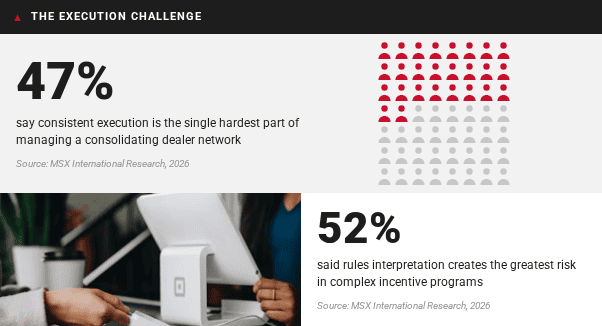
Across the campaign, the findings pointed to the same underlying issue. 47% of respondents identified consistent execution as the hardest part of managing a consolidating dealer network, while 52% said rules interpretation creates the greatest risk in complex incentive programs. In both cases, the challenge is clear: strategy only delivers value when people across the network can understand it, apply it, and act on it consistently.

Graph showing 47% struggle with consistent execution in automotive retail.

This is the point where high-level strategy often meets a dead end. A transformation only matters if it changes what happens between a salesperson and a customer, or a service advisor and a vehicle owner. If it doesn’t scale consistently across every market and every touchpoint, it isn’t transformation – it’s just paperwork.

Changing the sales model won’t fix a visibility problem

The industry is racing toward agency and hybrid models in search of control. But control requires clarity. Our research found that role clarity and network visibility were the primary concerns for 32% of respondents in these new models.

Graph showing 32% of respondents cite role clarity and network visibility concerns.
If a dealer doesn’t know where their responsibility ends and the OEM’s begins, the customer will be the first to find out. MSX CX Consultancy helps brands bridge this gap by redesigning journeys that actually function in a multi-channel world. To protect conversion at the digital stage, solutions like MSX E.COM Personal Landing Pages and MSX Consumer Engagement Solutions ensure that the customer doesn’t fall through the cracks of a disconnected handoff.

Scale is currently the enemy of consistency

As dealer groups consolidate, they gain massive scale – but they often lose grip on the “how.” When nearly half of the industry says consistency is their biggest headache, it proves that “bigger” isn’t “better” without a way to steer the ship.

You cannot manage a global network through a rear-view mirror. MSX ENGAGE provides the alignment necessary to keep large groups moving in unison, while APPRAISO turns static compliance into dynamic performance steering. If you can’t see the gap, you can’t close it.

Incentive complexity is an execution problem

Incentive schemes only steer behavior if the network understands them. Our research found that 52% of respondents identify rules interpretation as the greatest risk in complex programs, far outweighing concerns over audit readiness.

When rules are open to interpretation, inconsistency quickly erodes claims accuracy and partner trust. MSX Sales Incentive Audit program can support automotive brands in strengthening the governance, clarity, and audit trail behind incentive programs, helping ensure commercial activity is measured and rewarded with greater confidence.

Aftersales is where your revenue is leaking

While the industry obsesses over the “new car” sales model, the largest profit pool – aftersales – is under-managed. 34% of respondents identified service booking as the number one source of revenue leakage, outranking online leads and showroom follow-ups.

Graph showing 34% revenue leakage from service booking in automotive industry.

We are seeing a market where customers prioritize speed and ease over brand loyalty. If your booking journey is a barrier, your revenue is already gone. In the article Is convenience killing the automotive service industry?, we highlight that convenience is the new currency. MSX Mobile Service is a direct response to this, reclaiming capacity and utilization by meeting the customer where they are, rather than waiting for them to show up.

Data is noise if it doesn’t drive coaching

We are drowning in data but starving for insight. 30% of professionals told us that coaching impact and service performance are their biggest blind spots.

As we explored in Is the traditional KPI dead?, reporting what happened last month is no longer a management strategy. MSX Sales Performance uses diagnostics to uncover the why behind the numbers, ensuring that every intervention is targeted and measurable.

Stop training, start coaching

Perhaps the most telling finding was that 34% of respondents blame inconsistent coaching for stalling sales improvement, while 29% cited low adoption.

Graph showing coaching and adoption gap in automotive sales strategies.
The traditional “classroom” approach to retail improvement is failing. Change only happens when it is reinforced locally and daily. MSX COACH and our wider Learning Solutions move capability building out of the HR department and into the showroom flow, ensuring that strategy actually translates into behavior.

High stakes for high performance

The automotive retail landscape is being rebuilt. Whether the resulting structure is profitable or simply more complex depends entirely on your ability to close the gap between what you say you will do and what your network actually delivers. Transformation should not be a pilot program that never reaches scale; it should be the standard.

Your strategy is only as good as its last mile. If your transformation isn’t reaching the showroom floor, it isn’t delivering value.

Don’t let your strategy stall at the showroom door. Contact MSX to discuss how we can help you bridge the gap between strategy and a high-performing network.

Related Articles

The profit lifecycle: Where automotive profit is really won

The profit lifecycle: Where automotive profit is really won

Stop looking for profit in the wrong places. Profit is often viewed as the result of financial performance. It appears in margin reports, return on sales figures, aftersales revenue, and year-end results. Those measures matter, but they only tell part of the story. They show the outcome, not how it was achieved.

The reality is that profit is created, protected, and sometimes lost long before it appears on a financial statement. It starts when a vehicle enters the market and continues through every customer interaction, service visit, repair, recall, and operational decision that follows.

Between market entry and aftersales, the sales journey also plays a critical role in profitability. Solutions such as E.COM Personal Landing Pages and APPRAISO help brands strengthen customer engagement, support retailer performance, and create value from the moment a vehicle becomes available.

The organizations that consistently outperform their competitors understand that profitability is not owned by one department. It is influenced by how effectively the entire business works together. Faster market entry. Better repair quality. Reduced vehicle downtime. Smarter customer engagement. More efficient recalls. Stronger technical support. These may be viewed as separate activities, but each plays a role in shaping commercial outcomes. The most successful automotive businesses are beginning to connect these dots. They are shifting their focus from measuring profit at the end of the journey to understanding how value is created at every stage of it. Because in today’s automotive industry, profit doesn’t simply appear in the numbers. It follows the vehicle. It begins before the vehicle reaches the customer.

Homologation is often treated as a compliance task. In reality, it affects launch timing, internal coordination, retailer readiness, and time to market. When approvals move smoothly and documentation is well managed, businesses protect commercial momentum. When they do not, delay becomes cost. That is one reason MSX Homologation Services matter from a profitability point of view, not only a regulatory one

Once the vehicle is in market, profit becomes even more operational.

A sale creates revenue. The ownership journey determines how much value is retained and grown. Service access, technical accuracy, convenience, recall execution, and customer communication all shape whether a customer stays loyal and whether the network runs efficiently. This is where many organizations still underestimate margin loss.

In Is convenience killing the automotive service industry?, MSX highlighted something the industry is feeling every day: convenience has become a real driver of customer retention. If customers cannot book quickly, get clear updates, or access flexible service options, the cost is not only dissatisfaction. It is missed revenue, weaker retention, and lower lifetime value.

Customer engagement shows the same pattern. A leading automotive brand improved call conversion by 18% and achieved a further 6% conversion uplift through WhatsApp by moving from static outreach to real-time, needs-based contact. Better timing. Better relevance. Better results. Read the full story  .

Inside the workshop, profit is shaped by speed and clarity.

When technicians spend too long searching for repair information, or support teams are buried in repeat queries, productivity falls and downtime rises. In validation work with a leading multinational manufacturer, the MSX AI Virtual Assistant reduced support tickets by 30% and improved response times by 15% by helping technicians access technical service bulletins, repair manuals, and diagnostic trouble codes faster. That is operational efficiency with a direct commercial effect.

Repair quality is another area where workshop performance shapes profitability in ways that are easy to overlook. Repeat repairs, inconsistent diagnosis, and poor repair order discipline all create cost: rework, warranty exposure, customer dissatisfaction, and avoidable operational expense. MSX Repair Quality Support addresses this through a structured, data-led program that helps OEMs and dealer networks improve first-time fix rates (FTFR), standardize repair execution, and prioritize intervention where it has the greatest impact. The results are measurable: up to a 5% improvement in first-time fix and up to a 20% productivity increase across the network.

The same is true for technical content. Documentation often sits in the background, but slow publishing cycles and fragmented authoring processes create friction across the network. pubFoundry helps improve content flow, consistency, and speed, which supports better service performance and more efficient knowledge sharing.

A wider shift is happening here too.

This shift is changing how automotive businesses think about performance. In Beyond the numbers and Is the traditional KPI dead?, MSX explored why historical KPIs alone are no longer enough. Organizations need better context, better prediction, and a clearer understanding of what is driving performance – not just what has already happened.

That shift matters because profit is easier to protect when organizations can see problems early and act before cost becomes visible.

Profit is easiest to lose when complexity increases.

Recalls also deserve a place in the profit conversation. Poorly managed recalls do more than add cost. They put pressure on capacity, frustrate customers, and weaken trust. MSX Recall Management helps coordinate scheduling, capacity, and customer contact so that recalls are completed more efficiently and with less disruption. For fleet operators and mobility providers, lifecycle risk makes the point even more clearly. In this customer success story: Increasing fleet reliability, MSX showed how a preventative maintenance model could help a logistics operator avoid up to $13 million in annual spend. That is what happens when data is used early enough to protect value before cost becomes visible.

So where is profit really created?

Across all of these examples, the message is consistent: Profit is shaped through operational decisions, customer experience, service efficiency, compliance readiness, technical support, and lifecycle management.

In other words, profit follows the vehicle. The organizations that understand the profit lifecycle will be better positioned to identify hidden margin loss, strengthen customer loyalty, and create sustainable performance at every stage of the journey.

The question is not whether profit is being won or lost. The question is where.

Which stage of the vehicle lifecycle has the greatest impact on profitability in your organization? Connect with us to continue the discussion.

Related Articles

Intelligent engagement in action: Real-time alerts drive up 48% conversion rate

Intelligent engagement in action: Real-time alerts drive up 48% conversion rate

Fast facts

A global, leading automotive brand

The brand struggled to deliver timely, relevant service outreach due to outdated, contact methods that led to low engagement and missed opportunities.

Europe

MSX to launch a real-time, data-driven Connected Vehicle Care solution that integrates connected vehicle data with CRM systems, enabling intelligent, human-led outreach only when service is genuinely needed.

From static outreach to smart, real-time service

A global, leading automotive brand faced a growing challenge in delivering timely, relevant, and personalized customer service interventions. Traditional outreach methods, which relied heavily on predictive algorithms and static contact lists, often led to inefficient/intrusive communication, low engagement rates, and missed opportunities to connect meaningfully with customers. These limitations highlighted the need for a more intelligent, responsive, and human-centered approach to customer engagement – one that could harness real-time vehicle data, adapt dynamically to customer behavior, and deliver a seamless, end-to-end service brand experience across channels.

Smart outreach in action: The three pillars of the Connected Vehicle Care solution

To address these challenges, the brand partnered with MSX to implement a tailored solution. This initiative was designed to fundamentally reshape how vehicle alerts are processed and how customer outreach is conducted. The solution was structured around three core pillars:

People

A dedicated team of customer engagement consultants was trained to initiate contact only when a verified need for vehicle intervention was raised. This ensured that outreach was both relevant and respectful of the customer’s time.

Technology

The brand’s connected vehicle platform was seamlessly integrated within MSX’s CRM infrastructure, enabling real-time processing of vehicle-generated alerts and immediate routing to the appropriate service channels.

Data Integration

A streamlined data flow was established, allowing alerts to be automatically downloaded from the OEM’s system and uploaded into MSX’s CRM without the need for complex middleware or manual intervention. This reduced latency and improved operational efficiency.

The pilot program was launched with an initial focus on two high-impact alert categories: oil quality and scheduled maintenance. By prioritizing actionable insights and minimizing false positives, the solution enabled more intelligent, timely, and human-centered customer interactions.

Intelligence backed by industry insight

At the core of the solution lies a sophisticated algorithm designed to intelligently filter and prioritize vehicle alerts. This ensures that only customers with a verified and immediate need for service intervention are contacted, significantly improving the relevance of each interaction. Rather than depending on broad, automated triggers, the system uses a more selective and intelligent decision-making process that identifies and prioritizes only the most relevant and actionable alerts.

To further enhance this precision, MSX incorporates a pre-analysis layer that distinguishes between false positives and genuine service requirements. This additional step minimizes unnecessary outreach, streamlines operations, and ensures that customer engagement efforts are focused where they matter most.

Precision powered by industry expertise

The process is further strengthened by MSX’s industry expertise in interpreting connected vehicle data and navigating the complexities of dealer network operations. Armed with this insight, consultants can tailor each conversation to the customer’s specific context. They validate vehicle status, clarify the nature of the alert, and outline the next steps in a transparent and reassuring manner, building trust and reinforcing the brand’s commitment to proactive service.

In cases where customers are unreachable, the system automatically initiates a follow-up via WhatsApp. This alternative communication channel helps maintain engagement and offers customers a more convenient way to respond, ensuring that critical service needs are not overlooked due to missed calls.

Boosting trust, conversion and loyalty

The Connected Vehicle Care solution has delivered clear, measurable improvements across multiple dimensions of customer engagement and operational efficiency:

  • 18% increase in call conversion rates

    compared to traditional predictive calling methods, demonstrating the effectiveness of a real-time, needs-based outreach model.

  • 6% increase in conversion rate via WhatsApp

    used as a secondary communication channel, highlighting the value of offering customers flexible, convenient ways to respond.

  • Stronger customer trust

    fostered through transparent proposition, data-driven conversations that validate vehicle status and service needs in real time.

  • Improved loyalty

    achieved by delivering seamless, timely, and personalized service experiences that consistently reflect the OEM’s brand promise.

This initiative has redefined how the brand engages with its customers. By shifting from static, predictive outreach to a dynamic, real-time model, they have created a more responsive, relevant, and trusted service experience. The solution not only supports the company’s broader digital transformation goals but also preserves the human element that customers continue to value, ensuring that technology enhances, rather than replaces, personal interaction.

Importantly, the approach is fully aligned with GDPR compliance standards. Customer data is handled transparently and ethically, with alerts shared simultaneously with both the customer and the service team. This reinforces trust, ensures accountability, and enables seamless communication between all parties involved.

MSX Connected Vehicle Care demonstrates how technology and human insight can work hand in hand to deliver measurable impact. It sets a new benchmark for intelligent customer engagement – one that is scalable, compliant, and deeply aligned with the expectations of today’s connected drivers.

Future-ready innovation

Looking ahead, the focus will shift toward refining and scaling the solution to unlock even greater value. Key priorities include:

AI is transforming the inbound customer journey by enabling intelligent automation tailored to loyal, active, and digitally engaged customers. As AI capabilities evolve, elements of the proactive outbound process are also being digitized, allowing for smarter contact prioritization, optimal timing and channel selection, and the identification of cross-selling opportunities. Yet, the human touch remains essential for building trust, validating customer needs, and delivering personalized service. This solution is designed to evolve in parallel with technological advancements and increasing customer reliance on conversational AI, while keeping people at the heart of the experience. This initiative represents a pivotal advancement in redefining customer engagement for our client.

By moving from predictive to real-time, needs-based outreach, the brand has created a more responsive, transparent, and trusted service model. It not only supports broader digital transformation goals but also reinforces its commitment to ethical data use and customer-centric innovation.

Related case studies

Intelligent outreach for a connected era: Why mobility players must move beyond predictive contact models

Intelligent outreach for a connected era: Why mobility players must move beyond predictive contact models

In an age where cars can talk, why are so many customer conversations still stuck in the past? Traditional, predictive customer contact models, built on static data and generic triggers, are increasingly ineffective in today’s connected vehicle landscape. They often result in irrelevant outreach, low engagement, and missed opportunities to build trust and drive service revenue.
Research reveals that 71% of consumers expect companies to deliver personalized interactions, and 76% get frustrated when this doesn’t happen. And in automotive aftersales, this expectation is amplified by the growing availability of connected vehicle data. Yet many OEMs and dealer networks are not fully leveraging this data to create timely, relevant, and human-centered service experiences.

The need for real-time, needs-based communication

To overcome these challenges, the industry must embrace a more intelligent, proactive data-driven approach that integrates real-time connected vehicle data with CRM systems and empowers human consultants to act only when service is genuinely needed.

This model shifts the focus from prediction to precision. By using live data from connected vehicles, brands can identify actionable alerts, such as oil quality degradation or urgent maintenance needs and route them directly to trained consultants. These consultants can then engage customers with context-aware conversations that validate the alert, explain the next steps, promote the brand promise and offer convenient booking options.

This approach not only improves the relevance of each interaction but also respects the customer’s time and builds trust through transparency.

Real change demands more than good intentions

Implementing this model requires more than just technology, it’s a mindset change. It demands a coordinated strategy that brings together:

People

Skilled consultants who turn vehicle alerts into valuable customer conversations, with the tact to upsell, cross-sell, and build rapport.

Technology

Seamless integration between connected vehicle platforms and CRM systems and dealer schedulers to enable real-time alert processing and bookings.

Processes

Streamlined workflows that reduce inactivity, eliminate manual steps, and ensure consistent, GDPR-compliant communication.

When these elements align, the results are compelling. Brands that have adopted this approach have seen an 18% increase in conversion rates compared to traditional predictive methods.

Beyond conversion, this model also improves dealer efficiency by filling service bays with high-quality leads, reducing idle time, and enhancing workshop planning. And perhaps most importantly, it strengthens customer trust by ensuring that every interaction is timely, relevant, and respectful.

Smart service takes more than smart tech

The automotive industry doesn’t suffer from a lack of data, but instead a lack of timing, relevance, and trust. In a world where vehicles can signal their needs in real time, the real challenge is knowing when and how to act on the information being made available. Intelligent, human-led outreach is the difference between being part of the customer’s journey or not. But getting it right isn’t easy. It demands more than a new tool. It requires a new mindset, one that blends data with empathy, automation with judgment, and speed with purpose. Something that is difficult to automate without human intervention.

The future of service lies not in more contact, but in better contact. And while the path forward is clear, it’s not automatic. It takes intention, integration, and insight.

At MSX, we believe in building that future through solutions like MSX Connected Vehicle Care.

Contact the Author

Article_13_Michele_Esposito_small.webp

Michele Esposito

Global Solutions Director, Consumer Engagement

Article_13_Michele_Esposito_small

Michele Esposito

Global Solutions Director, Consumer Engagement

Related Articles

Revolutionizing automotive leasing: Blending CX, tradition, and innovation

Revolutionizing automotive leasing: Blending CX, tradition, and innovation

Automotive leasing companies are facing many challenges that impact their ability to deliver seamless and efficient services to their customers. Addressing these pain points effectively is crucial for maintaining competitiveness and ensuring customer satisfaction. By identifying these key challenges, leasing companies can leverage data and technology to develop innovative mobility solutions, enhance operational efficiency, and improve customer satisfaction.

Identifying the key challenges

One of the biggest issues faced by leasing companies, particularly those overseeing large fleets, is maximizing fleet utilization. Inefficient use of pool fleets often leads to higher costs as companies must depend more on external rental providers. To reduce cost and enhance service delivery, it is crucial to ensure optimal use of the available vehicles.

Customers expect reliable and prompt access to vehicles and any delays or failures in providing mobility solutions can result in their dissatisfaction. Complicated and slow booking procedures can frustrate customers and impede operational efficiency, so streamlining and simplifying the booking processes is vital for maintaining a positive customer experience.

Maintaining effective, continuous, and clear communication with customers also helps manage expectations and ensures satisfaction throughout the service lifecycle. By addressing these issues, leasing companies can improve their operations and better meet customer needs.

Empowering success through data and technology

Advanced data analytics provide valuable insights into fleet utilization, customer preferences, and operational efficiencies. Data analysis can inform decisions regarding vehicle allocation, maintenance schedules, and service improvements. Predictive analytics also aid in forecasting demand, enabling better resource planning and reducing reliance on external rentals.

Implementing innovative technology solutions is crucial for streamlining operations. Integrated booking systems, customer relationship management (CRM) platforms, and real-time vehicle tracking are essential components. Connected vehicle technology, for example, offers real-time data on vehicle locations and conditions, allowing for more precise fleet management and offering real-time insights into vehicle status, location, and usage patterns.

Efficient communication channels and automated systems, such as AI-powered chatbots, maintain customer satisfaction and provide instant responses to customer inquiries, while comprehensive CRM systems ensure all customer interactions are logged and addressed promptly. By leveraging these technological advancements, leasing companies can enhance their operational efficiency and improve overall customer experience.

Balancing tradition and technology

But while modern technology and data analytics are pivotal, traditional channels remain essential in ensuring comprehensive customer service and operational efficiency. Traditional call centers continue to play a crucial role in managing customer interactions. Personal connections with knowledgeable agents provide reassurance and detailed support that automated systems might not fully replicate.

Maintaining strong relationships with dealers is essential for efficient fleet management. Regular in-person visits help reinforce these relationships, ensuring dealers are aligned with the leasing company’s objectives and can facilitate quicker resolution of issues.

Traditional communication channels continue to be effective in reaching a broader audience and are particularly useful in marketing new services and educating customers about the benefits of leasing options. Combining traditional media with digital channels ensures a comprehensive communication strategy.

Embracing advanced technologies for success

As we look to the future, the integration of AI and other emerging technologies will play a pivotal role in transforming mobility solutions, helping to enhance operational efficiency and optimize decision-making processes. Implementing scalable solutions that adapt to varying levels of demand is crucial for maintaining efficiency, helping leasing companies meet customer needs without incurring unnecessary costs.

In this complex landscape, leasing companies must leverage data analytics, adopting advanced technologies and maintaining effective communication channels to ensure customer satisfaction and operational efficiency. The integration of AI and connected vehicle technology further enhances these capabilities, providing a clear pathway to success.

MSX Consumer Engagement services provide solutions that enhance every interaction with more personalized guidance and inspire consumers throughout their entire journey. We deliver support that goes beyond traditional contact center services, and boost consumer loyalty through seamless issue resolution and value enhancing engagement.

Elvira_Llorens

Elvira Llorens

CEO Octago

Elvira_Llorens

Elvira Llorens

CEO Octago

Related Articles

Revolutionizing automotive retail: The impact of personalized marketing

Revolutionizing automotive retail: The impact of personalized marketing

In today’s consumer-driven landscape, where relevance, efficiency and personalization are paramount, the evolution from mass marketing to personalized strategies has transitioned from a trend to a strategic imperative. This shift is poised to elevate customer engagement, bolster brand loyalty, and drive business success.

The essence of a tailored automotive marketing strategy

Personalized marketing is a customer-centric approach that utilizes data-driven insights to deliver experiences, messages, and offers tailored to individual needs, preferences, and behaviors. The core of this model is its ability to forge deeper connections with customers, fostering relevance, elevating satisfaction, and ultimately, driving conversions.


Relevance and efficiency

Creating individualized customer communications ensures each interaction is meaningful and related to the intended customer. By presenting relevant information, it streamlines the customer’s journey, reducing the time and effort customers spend searching for what they need.

Enhanced customer experience

Customers value feeling appreciated and understood. Personalized experiences make customers feel acknowledged and catered to, leading to a higher level of customer satisfaction and brand loyalty.

Increased conversion rates and retention

Targeted experiences resonate more with customers, leading to higher conversion rates and improved customer retention.

Data-driven insights

The application of data analytics results in better product recommendations, service offerings, and enhanced customer service. It enables brands to anticipate and proactively address customer needs.

Applications in the automotive industry

In the automotive industry, personalized marketing can take on various forms. By leveraging customer data and analytics, automotive companies can offer tailored vehicle recommendations that align with individual preferences, needs, and budgets, increasing the likelihood of conversion. Analyzing individual vehicle usage and maintenance history enables companies to send customized service reminders, ensuring timely maintenance and boosting customer satisfaction. Personalized marketing allows automotive companies to present financing options that accommodate the individual financial circumstances and preferences of each customer, facilitating a smoother purchasing process. Meanwhile, through targeted marketing communications, automotive brands can convey relevant offers, promotions, and information, fostering engagement and building enduring customer relationships. By aligning their offerings with customer needs and preferences, automotive companies can elevate the customer experience and drive business success.

Challenges and opportunities

While personalized marketing brings numerous benefits, it also poses obstacles that automotive companies must overcome. Challenges related to data privacy and security, technology integration, and measuring success are pivotal considerations in implementing personalized strategies.

Data privacy and security

Given the reliance on customer data, automotive companies must address data privacy and security concerns, ensuring regulatory compliance and building trust with customers.

Technology integration

Integrating advanced technology and tools is vital for crafting targeted experiences. Automotive companies need to stay updated on technological advancements and adapt to emerging trends to maintain competitiveness.

Measuring success

Establishing and measuring success is essential for assessing the efficacy of personalized marketing strategies. Automotive companies need to define clear KPIs and continuously monitor and adjust their strategies to achieve the desired outcomes.

Using data to enhance the service offering

But the generation of customer-centric data allows automotive companies to introduce preventative and pre-emptive services. An article from S&P Global Mobility, published in Sept 2023, suggests that the rise in powertrains and the consequent increasing portfolio of vehicles mean that manufacturers must adjust their marketing budget across a broader lineup, and every marketing campaign and initiative must be tailored to serve a specific customer to ensure maximum return.

By harnessing the power of advanced analytics and telematics, OEMs can offer predictive maintenance, giving customers real-time insights into their vehicle’s health and proactively scheduling maintenance or repairs based on actual usage patterns. This data-driven approach enables automotive companies to not only enhance safety and reliability but also reduce the overall cost of ownership for their customers. Additionally, it paves the way for personalized driving tips and efficiency recommendations, promoting a more eco-friendly and economical driving experience. In this data-driven era, automotive companies are not just selling vehicles; they are selling peace of mind and a more seamless, informed, and customized ownership journey.

Driving customer-centric innovation

The automotive industry is at the forefront of creating personalized, relevant, and valuable customer experiences. Driven by consumer demand, this personalized marketing model emerges as a beacon of innovation, providing a pathway to enhanced customer experiences, stronger relationships, and sustained business growth. As automotive companies continue to adopt this approach, the road ahead is filled with opportunities. The journey towards a future where every interaction is personalized, every experience is relevant, and every engagement adds value is well underway, with the automotive industry leading the way in redefining customer relationships and setting new standards for customer-centric excellence.

Contact the Author

Michele_Esposito

Michele Esposito

 Global Solutions Leader, Consumer Engagement

Contact the Author

Michele_Esposito

Michele Esposito

Global Solutions Leader, Consumer Engagement


Related Articles

Life-long loyalty starts here: Service bookings double with effective lead management

Life-long loyalty starts here: Service bookings double with effective lead management

Fast facts

Leading European national sales company

Improve vehicle servicing process and increase bookings

Europe

MSX’s end-to-end Service Lead Management solution includes web-based service booking technology, fully integrated with an omnichannel management system empowering agents to reach out to customers for dealers.

Initiating the conversation

Today’s automotive businesses are working harder to drive new or lost customers back to their service networks by revising their strategies to compete with the growing number of independent competitors.

Despite their endeavors, some of the world’s most successful OEMs continue to seek support in minimizing a decline in their customer retention figures.

The European national sales company of a leading brand was keen to improve its vehicle servicing process and increase the number of customers booking service appointments. The company’s customer relationship management system was designed to forecast vehicle servicing requirements and dispatch notifications to owners. However, the booking process relied only on customer-initiated contact.

MSX’s Service Lead Management solution almost doubled visits, achieving 90,000 bookings.

Building stronger connections

The European NSC partnered with MSX to deploy a Service Lead Management solution, which comprises a contact center whose professional agents contact customers on behalf of dealers.

The end-to-end solution implemented by MSX offers full transparency of interactions and progress. Using a modern omnichannel management system, contact center agents connect directly with customers who have failed to book a service within a set timeframe. Combining people, process and a web-based service booking technology, the solution optimizes appointment bookings and provides a comprehensive system for efficient customer service and appointment scheduling, including replacement cars.

By tracking the coverage rate (proportion of contacts called), conversion rate (contacted numbers that translate to bookings) and visit rate (bookings that translate to visits), the European NSC can monitor dealer performance and support those whose strategies need adjusting.

The MSX customer service team analyzes the contact center feedback including the reasons customers provide for not booking a service. They also examine variables like car line, car size, vehicle age, and registration details. Using these customer insights, the team can develop targeted services and special offers for dealerships or customers.

Driving up revenue

Since its first year of deployment, MSX’s Service Lead Management solution almost doubled the number of service visits, achieving 90,000 bookings, of which 85% converted to visits, generating significant additional revenue.

During the first three years, the percentage of contacted customer visits increased from 13% to 23%.

The solution has also helped the organization recover and retain customers, and in some dealerships, the additional business has yielded a return on investment of 12:1.

Upholding brand promises

The deployment of this program has proven to be transformative, empowering the brand to expand its new modular approach from a local to a global initiative.

Data gathered by MSX helps gather from national campaigns and promotions provides the OEM with valuable insight. Figures from early in the project revealed that customers are more interested in fixed prices than discounts, inspiring the brand to deploy fixed-price services to suit each dealer. The organization has since rolled out national fixed pricing and can promote all its services in line with the overall brand promise. OEM provides customers with seamless, transparent, and convenience-led offerings such home collection, which help encourage satisfaction and loyalty.

MSX continues to manage bookings and customer visits, communicating in relevant languages and using local knowledge to adapt to regional needs. The service reassures the OEM that its offers are promoted and delivered consistently and on brand. Dealers are better supported in their roles and have more time to focus on the sale of additional products while providing customers with a more personalized and efficient service.

ROI
0 :1
increase in bookings from year 1
0 %
Customer visits increase
> 0 %

Real-time personalized marketing

MSX continues to partner with the brand, utilizing connected vehicle data to provide tailored marketing strategies in real time that foster customer loyalty through efficient and proactive support.

MSX also supports projects that deliver personalized marketing strategies that incorporate connected vehicle data. Vehicle information will deliver more accurate assessments on vehicle health, including recommended service timings, to retailers. Services such as these not only help to minimize the time, effort and intrusion of unnecessary phone calls, but also provide safe and efficient monitoring of vehicles, helping to keep them on the road longer while better supporting customers and inspiring their loyalty.

Find out more about how MSX Service Lead Management solutions can help your business.

Related case studies