Retail denial: Why automotive strategies are dying in the showroom

Retail denial: Why automotive strategies are dying in the showroom

Automotive retail is currently suffering from a dangerous disconnect. While many head offices are moving away from a single sales model in favor of flexible hybrid arrangements, a new gap is opening between strategy and reality.

These hybrid models are designed to find a perfect balance: OEMs can act as agents for high-value products to maintain brand control, while dealers keep their independence in other areas to stay responsive to their local markets. It sounds like the perfect compromise, but the execution is falling further behind. We are seeing an industry-wide “denial gap,” where the sheer complexity of managing these blended roles is quietly suffocating the very transformations designed to save the network.

We launched our nine-week Sales and Revenue Transformation campaign to move beyond theoretical discussions and uncover where the commercial journey is actually breaking down. By examining the transition to these new hybrid models and the resulting pressure points in retail and service, we aimed to identify the practical barriers that prevent MSX clients – both OEMs and dealer groups – from recovering lost revenue.

The feedback from over 500 automotive specialists, retail leaders, and commercial experts who participated in our research was clear: the industry doesn’t have a strategy problem. It has an execution crisis.

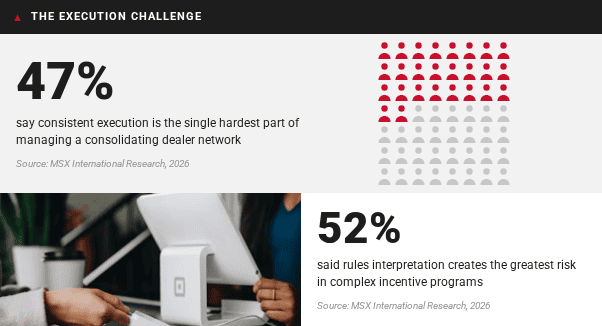
Across the campaign, the findings pointed to the same underlying issue. 47% of respondents identified consistent execution as the hardest part of managing a consolidating dealer network, while 52% said rules interpretation creates the greatest risk in complex incentive programs. In both cases, the challenge is clear: strategy only delivers value when people across the network can understand it, apply it, and act on it consistently.

Graph showing 47% struggle with consistent execution in automotive retail.

This is the point where high-level strategy often meets a dead end. A transformation only matters if it changes what happens between a salesperson and a customer, or a service advisor and a vehicle owner. If it doesn’t scale consistently across every market and every touchpoint, it isn’t transformation – it’s just paperwork.

Changing the sales model won’t fix a visibility problem

The industry is racing toward agency and hybrid models in search of control. But control requires clarity. Our research found that role clarity and network visibility were the primary concerns for 32% of respondents in these new models.

Graph showing 32% of respondents cite role clarity and network visibility concerns.
If a dealer doesn’t know where their responsibility ends and the OEM’s begins, the customer will be the first to find out. MSX CX Consultancy helps brands bridge this gap by redesigning journeys that actually function in a multi-channel world. To protect conversion at the digital stage, solutions like MSX E.COM Personal Landing Pages and MSX Consumer Engagement Solutions ensure that the customer doesn’t fall through the cracks of a disconnected handoff.

Scale is currently the enemy of consistency

As dealer groups consolidate, they gain massive scale – but they often lose grip on the “how.” When nearly half of the industry says consistency is their biggest headache, it proves that “bigger” isn’t “better” without a way to steer the ship.

You cannot manage a global network through a rear-view mirror. MSX ENGAGE provides the alignment necessary to keep large groups moving in unison, while APPRAISO turns static compliance into dynamic performance steering. If you can’t see the gap, you can’t close it.

Incentive complexity is an execution problem

Incentive schemes only steer behavior if the network understands them. Our research found that 52% of respondents identify rules interpretation as the greatest risk in complex programs, far outweighing concerns over audit readiness.

When rules are open to interpretation, inconsistency quickly erodes claims accuracy and partner trust. MSX Sales Incentive Audit program can support automotive brands in strengthening the governance, clarity, and audit trail behind incentive programs, helping ensure commercial activity is measured and rewarded with greater confidence.

Aftersales is where your revenue is leaking

While the industry obsesses over the “new car” sales model, the largest profit pool – aftersales – is under-managed. 34% of respondents identified service booking as the number one source of revenue leakage, outranking online leads and showroom follow-ups.

Graph showing 34% revenue leakage from service booking in automotive industry.

We are seeing a market where customers prioritize speed and ease over brand loyalty. If your booking journey is a barrier, your revenue is already gone. In the article Is convenience killing the automotive service industry?, we highlight that convenience is the new currency. MSX Mobile Service is a direct response to this, reclaiming capacity and utilization by meeting the customer where they are, rather than waiting for them to show up.

Data is noise if it doesn’t drive coaching

We are drowning in data but starving for insight. 30% of professionals told us that coaching impact and service performance are their biggest blind spots.

As we explored in Is the traditional KPI dead?, reporting what happened last month is no longer a management strategy. MSX Sales Performance uses diagnostics to uncover the why behind the numbers, ensuring that every intervention is targeted and measurable.

Stop training, start coaching

Perhaps the most telling finding was that 34% of respondents blame inconsistent coaching for stalling sales improvement, while 29% cited low adoption.

Graph showing coaching and adoption gap in automotive sales strategies.
The traditional “classroom” approach to retail improvement is failing. Change only happens when it is reinforced locally and daily. MSX COACH and our wider Learning Solutions move capability building out of the HR department and into the showroom flow, ensuring that strategy actually translates into behavior.

High stakes for high performance

The automotive retail landscape is being rebuilt. Whether the resulting structure is profitable or simply more complex depends entirely on your ability to close the gap between what you say you will do and what your network actually delivers. Transformation should not be a pilot program that never reaches scale; it should be the standard.

Your strategy is only as good as its last mile. If your transformation isn’t reaching the showroom floor, it isn’t delivering value.

Don’t let your strategy stall at the showroom door. Contact MSX to discuss how we can help you bridge the gap between strategy and a high-performing network.

Related Articles

Transforming EV lead conversion: Delivering tailored, data-driven customer experiences

Transforming EV lead conversion: Delivering tailored, data-driven customer experiences

Fast facts

European volume OEM

With an excess of electric vehicles returning from leasing contracts, the OEM needed a more personalized approach to optimize customer engagement and sales conversion rates.

Germany

MSX E.COM Personal Landing Page (PLP) program delivered tailored, data-driven experiences for customers, allowing for automated communications and follow-ups, and provided clear options for customers to buy, extend their lease, or opt out.

A European volume OEM found itself with an excess of electric vehicles returning from leasing contracts that needed to be sold or have their lease terms extended. Despite the inherent customer interest, the traditional lead conversion approach lacked the level of personalization needed to optimize customer engagement and conversion rates.

The organization approached MSX with the specific challenge and sought a comprehensive solution that could transform its sales approach. MSX recognized the need for a more dynamic and personalized customer engagement strategy to effectively manage the influx of returning electric vehicles.

Without a digital strategy that could support direct and tailored communication, the OEM’s existing sales processes were proving inefficient. The retail group required a solution that could centralize customer interactions, streamline communications, and drive higher conversions.

MSX implemented its innovative MSX E.COM Personal Landing Page (PLP) program to address the client’s needs. The PLP program is designed to create personalized and OEM branded data-driven experiences for customers by combining advanced software and automated communication strategies.


Introducing personalized digital strategies

To address the challenge, MSX implemented a solution centered around customized PLPs. Each lead, or customer, received a unique landing page tailored specifically to their vehicle details and status in the sales funnel. This personalized approach allowed customers to view offers that were relevant to their lease status and preferences, whether it was to purchase their current vehicle or extend their lease. By providing this level of customization, they could engage customers more effectively and cater to their individual needs.

The system also featured automated communication and engagement, which played a crucial role in maintaining customer interest. Personalized emails and follow-up messages were automatically triggered based on each customer’s response and engagement levels. If a customer did not respond within three days, the system would initiate additional outreach via the PLP or a specialized inside sales agent to keep the customer engaged. This automation ensured that no potential lead was overlooked, and that communication remained consistent and timely.

Each PLP provided customers with three straightforward options: to buy the car, extend the lease, or opt out. This clarity, combined with a user-friendly interface, empowered customers to make decisions on their own terms. By simplifying the choices and making the process transparent, the OEM could enhance customer satisfaction and trust.

The PLP campaign was designed to operate with minimal human intervention, allowing the sales teams to focus on high-potential leads. The automated system managed the bulk of the interactions, ensuring that within two months, all 1,300 customers received a consistent and personalized experience. This approach not only improved efficiency but also allowed the sales team to allocate their efforts more strategically, ultimately driving higher conversion rates.

Each PLP provided customers with three straightforward options: to buy the car, extend the lease, or opt out. This clarity, combined with a user-friendly interface, empowered customers to make decisions on their own terms. By simplifying the choices and making the process transparent, the OEM could enhance customer satisfaction and trust.

The PLP campaign was designed to operate with minimal human intervention, allowing the sales teams to focus on high-potential leads. The automated system managed the bulk of the interactions, ensuring that within two months, all 1,300 customers received a consistent and personalized experience. This approach not only improved efficiency but also allowed the sales team to allocate their efforts more strategically, ultimately driving higher conversion rates.

Transforming sales with automated communication

The introduction of MSX’s PLP program brought several significant benefits to the OEM’s sales process. One of the most notable advantages was the enhanced personalization of customer interactions. Each communication and offer were tailored to the customer’s current situation and preferences, ensuring that every message was relevant and engaging. This level of customization helped build stronger relationships with customers and increased their likelihood of responding positively to the offers presented.

The system automated all communications and follow-ups, which significantly reduced the manual workload for the OEM’s salesforce. This automation ensured that messages were sent in a timely and consistent manner, maintaining customer engagement without the need for constant manual intervention. As a result, the sales teams could focus their efforts on more strategic tasks, knowing that the system was handling routine follow-ups efficiently.

With a centralized platform to track responses and analyze customer behaviors, The group’s sales teams could easily identify and prioritize the hottest leads. This streamlined approach allowed for a more efficient use of resources, as the teams could concentrate on leads that were most likely to convert. The ability to quickly and accurately assess customer interest meant that sales efforts were more targeted and effective.

By combining advanced software with automated communication strategies, the OEM was able to engage customers more effectively and drive higher levels of engagement. The result was a significant increase in conversions, demonstrating the value of a tailored, data-driven approach to customer interaction and sales management.

Optimizing sales with data insights

The results of the PLP campaign were exceptional, showcasing the potential of MSX’s data-driven sales strategies. Out of 1,300 potential leads, the campaign generated over 500 conversions, with 300 customers signing contracts to purchase their vehicles directly through the PLP and an additional 200 supported through other sales channels. This translated into a 43% conversion rate from engaged leads to hot leads, significantly higher than traditional sales methods, demonstrating the effectiveness of personalized communication in capturing customer interest.

They also saw an 80% improvement in segmentation accuracy, allowing them to target their communications more precisely. Additionally, there was a 63% success rate in personalized outreach compared to their standard, non-personalized campaigns. These metrics highlight the efficiency and effectiveness of the PLP program in enhancing customer engagement and driving sales.

By blending innovative technology with human-centric processes, our client was able to achieve superior outcomes, leveraging MSX E.COM’s capabilities to move inventory quickly, engage customers more effectively, and transform their approach to lead management and conversion.

The combination of a tailored PLP solution, data-driven insights, and automated communication resulted in a comprehensive solution that went beyond addressing their immediate challenge. It set a new standard for personalized customer engagement in automotive sales. The program’s success is a clear indicator of how a well-executed PLP solution can drive tangible business results, paving the way for future implementations across their network.

More than 500 conversions, including 300 direct purchases and 200 through other channels.

Conversion rate from engaged leads to hot leads.
0 %
Improvement in segmentation accuracy.
0 %
Success rate in personalized outreach compared to standard campaigns.
0 %

Related case studies

Optimizing conversions: Boosting efficiency and driving growth with non-human lead management

Optimizing conversions: Boosting efficiency and driving growth with non-human lead management

Fast facts

An American EV disruptor

Struggling with inefficiencies and conversion rates in lead management, particularly when it comes to integrating human interactions with digital tools, our client identified a pressing need for a solution that would allow customers to choose how they communicate, while also enabling them to maintain a high level of personalization and efficiency.

Europe

A digital solution that merges cutting-edge AI, automation, and human interaction to create a flexible, scalable, and modular approach to lead management, catering to different customer preferences while ensuring cost efficiency for OEMs.

The automotive industry has long faced challenges in lead management, especially in seamlessly integrating human interactions with digital tools and ensuring transparent follow-up throughout the sales journey to the point of conversion. Balancing customer preferences for personalized communication with the need for scalable and cost-effective processes can be a challenge for OEMs. Additionally, fluctuating workloads make it difficult to rely solely on full-time employees (FTEs), as human interactions require flexibility that can be difficult to achieve with a traditional workforce.

While most OEMs run marketing campaigns across various digital platforms such as Meta, Instagram, and LinkedIn, they often struggle to effectively capture and engage leads. They require the correct coding in place to capture lead data and turn this initial interest into successful conversions via personalized interactions. However, some customers still value human contact, especially when making significant decisions like purchasing a vehicle.

One American EV disruptor urgently needed a solution that would allow customers to choose their preferred communication methods, while also enabling them to maintain high levels of personalization and efficiency. This solution would ensure continuous follow-up throughout the sales journey, from lead to conversion.

Merging AI, automation, and human interaction

MSX developed an innovative, digital lead management solution that merges cutting-edge AI, automation, and human interaction to create a flexible, scalable process. This approach was designed to cater to different customer preferences while ensuring cost efficiency for OEMs.

The key to this solution is a modular approach to lead management that could adapt to varying levels of human involvement. Using advanced data gathering techniques from a variety of channels (including dealer systems, customer relationships management platforms, and social media channels), MSX compiled leads from diverse sources like Meta, Instagram, and web advertisements. Once customer data was captured, the system applied sophisticated clustering algorithms, utilizing 12 criteria to categorize leads into five distinct clusters based on purchase intent. This granular approach allowed for highly targeted communication tailored to the needs of each customer.

person-working-futuristic-office

” By implementing a digital-first approach with minimal human interaction, the company saw a dramatic increase in lead conversion rates, boosting discovery-to-conversion rates from 50% to 90%.”

Personalizing the customer journey

Customers were then presented with personalized landing pages (PLPs) that contained detailed vehicle information, offers, and options for further engagement. Depending on their cluster, customers could choose to continue their journey digitally via WhatsApp, connect with a salesperson, or schedule a test drive. The entire process, from lead generation to the final stages of conversion, was streamlined and digital, with human involvement only occurring when necessary—such as during a test drive.

In less than two months, MSX successfully developed a customized digital solution that aligned with the specific brand DNA and met the unique expectations of its customers, an impressive achievement given the complexity of the integration across multiple platforms. The modular design is fully customizable, allowing OEMs to adjust the level of human interaction as needed, depending on customer preferences or campaign demands. Whether the OEM is running a new vehicle launch, a seasonal campaign, or targeting a specific geographic region, the system’s scalability ensures that resources can be adjusted quickly and efficiently.

This approach allows the OEM, or lead management hub, to select only the elements they need, such as digital lead capture, personalized communication via PLPs, or direct sales team integration, making this solution flexible, and adaptable to the unique needs of the client.

Delivering unmatched efficiency and engagement

MSX’s digital lead management solution offered a host of benefits that addressed the OEM’s challenges and exceeded expectations:

  • Cost efficient

    By reducing reliance on full-time employees (FTEs), the solution lowered labor costs and optimized resource usage. The ability to scale human interaction up or down based on demand provided significant operational savings.

  • Scalable and fexible

    The system is highly adaptable to different market conditions, campaigns, and geographic expansions. The OEM quickly adjusted their approach based on shifting customer needs or varying lead volumes.

  • Personalized engagement

    With advanced AI and data clustering, MSX was able to deliver highly personalized customer experiences. The use of customer intelligence platforms (CIP) and customer data platforms (CDP) allowed for better targeting, improving the relevance of messages sent to leads.

  • Higher conversation rates

    By delivering tailored communications and allowing customers to choose how they interact with the brand, MSX’s solution increased lead conversion rates. The personalized landing pages, targeted offers, and seamless transition to human sales agents or digital tools significantly improved customer engagement.

  • Data migration

    The system allows two-way communication via data API migration, meaning there’s no need for a complex CRM integration or DMS interface. An MSX layer over the existing CRM provides more robust functionality and flexibility, while significantly enhancing convenience for both customers and the network.

By integrating AI, automation, and personalized customer experiences, MSX provided a solution that not only boosted operational efficiency but also significantly enhanced customer engagement and conversion rates. The OEM now benefits from a scalable, flexible solution that can be tailored to meet the demands of a rapidly evolving market, keeping them ahead of the competition while delivering exceptional customer experiences. Additionally, the entire sales journey is meticulously documented, offering the OEM transparent and detailed reporting at every stage.

Related case studies