The profit lifecycle: Where automotive profit is really won

The profit lifecycle: Where automotive profit is really won

Stop looking for profit in the wrong places. Profit is often viewed as the result of financial performance. It appears in margin reports, return on sales figures, aftersales revenue, and year-end results. Those measures matter, but they only tell part of the story. They show the outcome, not how it was achieved.

The reality is that profit is created, protected, and sometimes lost long before it appears on a financial statement. It starts when a vehicle enters the market and continues through every customer interaction, service visit, repair, recall, and operational decision that follows.

Between market entry and aftersales, the sales journey also plays a critical role in profitability. Solutions such as E.COM Personal Landing Pages and APPRAISO help brands strengthen customer engagement, support retailer performance, and create value from the moment a vehicle becomes available.

The organizations that consistently outperform their competitors understand that profitability is not owned by one department. It is influenced by how effectively the entire business works together. Faster market entry. Better repair quality. Reduced vehicle downtime. Smarter customer engagement. More efficient recalls. Stronger technical support. These may be viewed as separate activities, but each plays a role in shaping commercial outcomes. The most successful automotive businesses are beginning to connect these dots. They are shifting their focus from measuring profit at the end of the journey to understanding how value is created at every stage of it. Because in today’s automotive industry, profit doesn’t simply appear in the numbers. It follows the vehicle. It begins before the vehicle reaches the customer.

Homologation is often treated as a compliance task. In reality, it affects launch timing, internal coordination, retailer readiness, and time to market. When approvals move smoothly and documentation is well managed, businesses protect commercial momentum. When they do not, delay becomes cost. That is one reason MSX Homologation Services matter from a profitability point of view, not only a regulatory one

Once the vehicle is in market, profit becomes even more operational.

A sale creates revenue. The ownership journey determines how much value is retained and grown. Service access, technical accuracy, convenience, recall execution, and customer communication all shape whether a customer stays loyal and whether the network runs efficiently. This is where many organizations still underestimate margin loss.

In Is convenience killing the automotive service industry?, MSX highlighted something the industry is feeling every day: convenience has become a real driver of customer retention. If customers cannot book quickly, get clear updates, or access flexible service options, the cost is not only dissatisfaction. It is missed revenue, weaker retention, and lower lifetime value.

Customer engagement shows the same pattern. A leading automotive brand improved call conversion by 18% and achieved a further 6% conversion uplift through WhatsApp by moving from static outreach to real-time, needs-based contact. Better timing. Better relevance. Better results. Read the full story  .

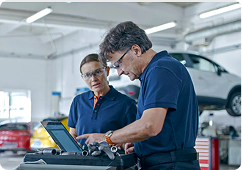
Inside the workshop, profit is shaped by speed and clarity.

When technicians spend too long searching for repair information, or support teams are buried in repeat queries, productivity falls and downtime rises. In validation work with a leading multinational manufacturer, the MSX AI Virtual Assistant reduced support tickets by 30% and improved response times by 15% by helping technicians access technical service bulletins, repair manuals, and diagnostic trouble codes faster. That is operational efficiency with a direct commercial effect.

Repair quality is another area where workshop performance shapes profitability in ways that are easy to overlook. Repeat repairs, inconsistent diagnosis, and poor repair order discipline all create cost: rework, warranty exposure, customer dissatisfaction, and avoidable operational expense. MSX Repair Quality Support addresses this through a structured, data-led program that helps OEMs and dealer networks improve first-time fix rates (FTFR), standardize repair execution, and prioritize intervention where it has the greatest impact. The results are measurable: up to a 5% improvement in first-time fix and up to a 20% productivity increase across the network.

The same is true for technical content. Documentation often sits in the background, but slow publishing cycles and fragmented authoring processes create friction across the network. pubFoundry helps improve content flow, consistency, and speed, which supports better service performance and more efficient knowledge sharing.

A wider shift is happening here too.

This shift is changing how automotive businesses think about performance. In Beyond the numbers and Is the traditional KPI dead?, MSX explored why historical KPIs alone are no longer enough. Organizations need better context, better prediction, and a clearer understanding of what is driving performance – not just what has already happened.

That shift matters because profit is easier to protect when organizations can see problems early and act before cost becomes visible.

Profit is easiest to lose when complexity increases.

Recalls also deserve a place in the profit conversation. Poorly managed recalls do more than add cost. They put pressure on capacity, frustrate customers, and weaken trust. MSX Recall Management helps coordinate scheduling, capacity, and customer contact so that recalls are completed more efficiently and with less disruption. For fleet operators and mobility providers, lifecycle risk makes the point even more clearly. In this customer success story: Increasing fleet reliability, MSX showed how a preventative maintenance model could help a logistics operator avoid up to $13 million in annual spend. That is what happens when data is used early enough to protect value before cost becomes visible.

So where is profit really created?

Across all of these examples, the message is consistent: Profit is shaped through operational decisions, customer experience, service efficiency, compliance readiness, technical support, and lifecycle management.

In other words, profit follows the vehicle. The organizations that understand the profit lifecycle will be better positioned to identify hidden margin loss, strengthen customer loyalty, and create sustainable performance at every stage of the journey.

The question is not whether profit is being won or lost. The question is where.

Which stage of the vehicle lifecycle has the greatest impact on profitability in your organization? Connect with us to continue the discussion.

Related Articles

When technology reaches its limit: Why human expertise is the final line of defense in complex vehicle diagnostics

When technology reaches its limit: Why human expertise is the final line of defense in complex vehicle diagnostics

In an industry racing toward AI-driven diagnostics, predictive maintenance algorithms, and multi-level remote technical support, there remains a critical “intelligence gap.” While digital tools excel at pattern recognition, there is a category of complex challenges where technology reaches its limit.

These are the cases where remote logs and automated databases cannot yet provide the answer, and where human judgment becomes the essential counterweight to technical uncertainty.

For OEMs, these unresolved cases represent more than just a technical hurdle; they are a direct threat to brand equity. When a vehicle remains at a dealership and Level 1 or Level 2 support has exhausted all options, the situation quickly escalates from a service delay to a significant commercial risk. This is where the Field Service Engineer (FSE) steps in – not merely as a service provider, but as a strategic intelligence asset and the final line of defense ensuring operational continuity and safeguarding the manufacturer’s long-term commercial interests.

When remote support is no longer enough

The automotive industry has made extraordinary progress in remote technical support. Multi-tiered helpdesks and AI-powered knowledge bases have dramatically improved first-time-fix rates. However, as we move toward the era of Software-Defined Vehicles (SDVs), the complexity of hardware-software “ghost” issues is increasing. Remote diagnostics often miss the nuanced physical symptoms or complex system interactions that only an on-site expert can capture.

These critical cases often involve:

Left unresolved, these rare but high-impact situations can damage customer loyalty and lead to costly litigation. At this stage, success depends on having the right expertise on the ground to protect the OEM’s reputation.

The Field Service Engineer advantage

An FSE is far more than a generalist technician. At MSX International, our Field Service Engineers are highly specialized professionals with extensive, OEM-specific expertise. Their proficiency extends beyond standard mechanical operation; they possess a comprehensive understanding of the vehicle’s design architecture, manufacturing processes, and engineering evolution.

This capability is built through:

Because MSX engineers operate across the entire automotive and mobility network, they are uniquely positioned to identify emerging failure patterns at an early stage. This proactive approach contributes directly to long-term quality enhancements and significantly reduces the “time-to-fix” across the entire organization.

Flexibility that matches real-world complexity

Field work is unpredictable. Managing high-priority escalations requires a structure that prioritizes agility. MSX supports this through coordinated deployment models and clear escalation pathways embedded within OEM workflows.

Crucially, our engineers have a deep understanding of how cases develop and the impact they have on your business. They can quickly identify when a technical fix might not be the best approach and when a wider commercial strategy is needed. This forward-thinking approach facilitates early risk mitigation, protecting your relationship with customers and reaching a positive result before a situation becomes too difficult to resolve.

Turning field insight into lasting improvement

One of the most valuable outcomes of Field Service Engineering happens after the case is solved. Every resolved issue is a piece of intelligence that strengthens the wider network. At MSX, we move from “reactive firefighting” to “proactive quality improvement” by:

Agility and cross-pollination: The partner advantage

For OEMs, the decision to build this capability in-house or partner with a specialist is a question of strategic agility. While internal teams are valuable, partnering with MSX offers a unique advantage: Cross-pollination.

Because MSX operates across multiple OEMs and global markets, we see failure patterns and diagnostic breakthroughs that an internal team, focused on a single brand, might miss. This broader perspective provides our partners with:

Strategic agility

The ability to scale deployment rapidly to meet fluctuating demand without the burden of fixed internal overheads.

Stability

Reduced risk associated with specialist turnover, ensuring institutional knowledge remains secure.

Innovation

Access to best practices derived from a global vantage point across the entire automotive landscape.

A strategic investment in brand confidence

Digital tools will continue to advance, and they are essential. But when the stakes are high, human judgment remains the ultimate safeguard. Field Service Engineers protect brand reputation, support dealers under pressure, and transform individual crises into lasting organizational improvements.

When a single unresolved issue can have serious legal or reputational consequences, having the right expertise in place is not a cost. It is a strategic investment in the future of your brand.


Ready to explore how Field Service Engineering can strengthen your aftersales operation? 

Contact the Author

Nicola Zorz

Global Solution Leader, Diagnostic & Repair Enhancement

Nicola Zorz

Global Solution Leader, Diagnostic & Repair Enhancement

Related Articles