Revving-up parts sales: Leveraging data-driven insights and strategic collaboration

Revving-up parts sales: Leveraging data-driven insights and strategic collaboration

Fast facts

A multinational volume manufacturer

A multinational volume manufacturer sought an opportunity to optimize its aftersales operations with the aim of enhancing efficiency, reducing costs, and improving customer satisfaction amidst evolving market dynamics.

Europe

A dedicated parts sales program restructured operations and utilized data-driven insights and advanced strategies to increase revenue and expand market reach.

A strategic overhaul of aftersales operations

At the time of the project, our client was challenged with increasing competition and evolving market dynamics. The automotive industry was undergoing significant transformation due to stricter emissions regulations, the rise of electric vehicles, and changing consumer preferences, driving the need for a strategic overhaul of their operations to stay competitive and meet new market demands.

One of the critical areas our client needed to address was its aftersales operations, particularly the parts distribution network in Italy. The company aimed to improve efficiency, reduce costs, and enhance customer satisfaction. Key challenges included ensuring optimal stock levels at distribution hubs to minimize stockouts, reducing excess inventory and associated costs while maintaining service levels, and streamlining the flow of parts from warehouses to dealerships to reduce delivery times.

The evolution and impact of the parts sales program

Launched in 2018, the program spanned nearly three years and evolved significantly over time, particularly due to the impact of COVID-19. Initially, the focus was on achieving parts sales targets for both the client’s authorized and multi-brand repair network by implementing 13 hubs dedicated to the sale of branded and private label products across Europe. In 2019, the program shifted its emphasis to optimizing internal processes at these hubs to boost the sell-out of original, multi-brand, and Independent aftermarket spare parts. By 2020, it had further evolved into a Dedicated Parts Sales Program for the brand’s multi-brand car service.

The implementation phase took approximately two to three months, dedicated to project structuring and recruiting over 40 individuals, both internally and externally. These resources included a management team consisting of one project manager and two analysts, four hub development managers, and various sales representatives for different repairer categories. We utilized a data visualization platform to create comprehensive and easily interpretable reports, which enhanced our ability to analyze information and optimize our parts distribution strategies effectively.
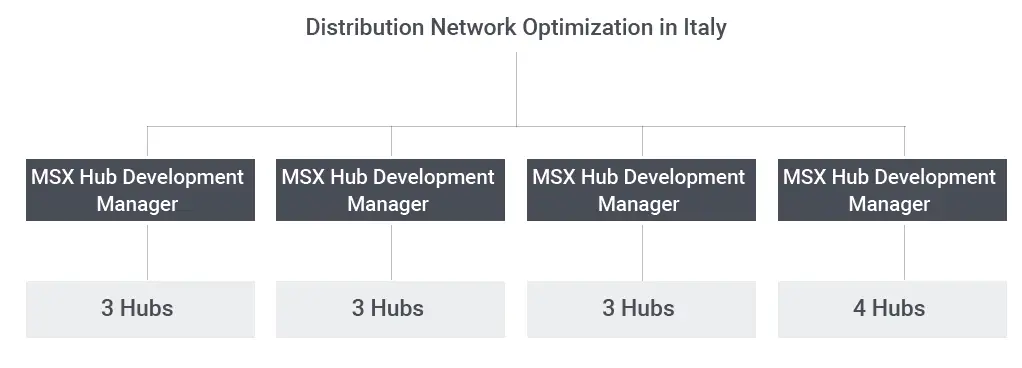
MSX’s data-driven approach provided crucial insights for our client during the launch of their parts distribution hubs in Italy. These analyses included national-level geographic coverage based on UIO (units in operation), advanced stock analysis beyond simple reorder mechanisms, and customer profiling. To optimize the distribution network, 13 hubs were divided equally among four MSX Hub Development Managers, considering the size of each business. Each manager was responsible for a team of nine field resources dedicated to supporting dealers, authorized repairers, and multibrand car service shops. Additionally, a central remote sales team was established to provide further support.

Significant growth and strategic adaptability

Despite its age and numerous iterations, the program demonstrated significant positive outcomes, particularly in its final phase. The multi-brand car service network, which marked the culmination of the project, experienced a remarkable 70% increase in annual parts sales. Additionally, the network expanded by 100 workshops, underscoring the solution’s potential to drive growth and broaden the service network. These impressive results, although specific to the later stages, provide valuable insights into the project’s overall impact and its capacity to stimulate substantial growth.

A key component of the project’s success was the data-driven approach employed by MSX. Utilizing UIO analysis, the team provided critical insights that were instrumental for our client during the launch of their Italian parts distribution hubs. These analyses were heavily relied upon to not only simplify reorder mechanisms but to also include advanced stock optimization strategies. This comprehensive approach ensured that every hub visit was informed by precise and actionable data, enhancing the efficiency and effectiveness of the parts distribution process.

Throughout the project’s duration, flexibility and adaptability were crucial. The evolving landscape required MSX to continuously pivot and adjust their strategies to meet changing circumstances. This ability to remain agile and responsive not only addressed immediate challenges but also positioned the project for long-term success.

The multi-brand Car Service Network, which marked the culmination of the project, experienced a remarkable 70% increase in annual parts sales.

Future considerations: Data-driven insights and collaborative success

Looking ahead, the program is set to build on its foundations, particularly its data-driven approach. The project has proven the critical role that data-driven insights play in optimizing distribution networks. By continuing to leverage advanced analytics and UIO analysis, MSX can further refine stock optimization strategies and enhance the efficiency of parts distribution, which will be pivotal in navigating the complexities of evolving market demands and ensuring sustained growth.

Equally important is the emphasis on collaboration. The success of the project so far has hinged on the strong partnerships between key stakeholders. Effective communication and coordination have been essential in aligning goals and executing strategies seamlessly. Moving forward, fostering these collaborative relationships will remain crucial. By maintaining open lines of communication and working closely with all parties involved, MSX can continue to drive innovation and achieve shared objectives, ensuring the program’s ongoing success and adaptability in a dynamic industry landscape.

Related case studies

Sky high ROI: Trade parts program achieves 600% ROI

Sky high ROI: Trade parts program achieves 600% ROI

Fast facts

Premium, global automotive manufacturer

Enhance trade parts operations and unlock greater potential

17 markets across Europe, North America, China, and South Africa

A customizable, modular trade parts strategy designed to transform the client’s ordering processes, pricing, and inventory management

Expanding parts’ potential

The trade parts business serves as a powerful catalyst for driving revenue and forging a strong foothold in the automotive market.

Amidst the proven successes of one of the world’s most esteemed automotive manufacturers, lay an exciting opportunity to enhance its trade parts operations further and unlock even greater potential. By implementing a well-structured wholesale parts program, effective marketing strategy, and streamlined data capture mechanism, the OEM expanded further in the fiercely competitive trade parts market.

Setting ambitious goals

The vehicle manufacturer engaged MSX for its visionary consultancy and to provide the necessary tools and solutions needed to empower its trade parts business in 17 markets across Europe, North America, China, and South Africa.

To unlock the brand’s true potential, MSX explored its existing trade parts activities, while embracing new opportunities and cultural factors. The goal was to develop a customizable trade parts strategy that would exceed expectations and propel the organization towards unparalleled success and achievements.

Employees are better equipped to sell and promote trade parts.

Exploring market opportunities

Having identified the different ways in which dealers manage their wholesale parts across each market, MSX designed and delivered a solution that comprised nine modules.

Each module focuses on a different area of the business, enabling individual markets to choose the specific elements that fit their needs. Delivered through a combination of people, process and technology, these modules address the needs of independent repairers and body shops, providing an easy way to buy and order parts, secure competitive prices, and ensure parts are in stock and delivered on time.

Through continuous evolution, small-scale marketing efforts have evolved into longer-term promotions, such as the ‘parts basket’ – a rebate program between dealers and the OEM that provides repairers and body shops with competitively-priced, preselected common parts. With the creation of a powerful data portal, MSX also enables teams to identify insights from global operations, further aided by dedicated data analysts examining the data daily to unveil opportunities and increase parts sales.

Celebrating brand success

The deployment of this program has proven to be transformative, empowering the brand to expand its new modular approach from a local to a global initiative.

MSX coaches continue to help dealers develop partnerships with their independent repairer customers, strengthening relationships and instilling trust and transparency. Employees are better equipped to do their jobs, with greater knowledge of the fundamentals of selling trade parts, and the tools to actively promote them to repairers and body shops.

The OEM is more informed thanks to comprehensive data analysis and reporting, allowing the team to focus on areas of the business most likely to generate revenue. The brand can introduce new strategies and implement offers and incentives to drive sales. Moreover, by understanding trends and patterns in data, it can respond to business fluctuations quickly and accurately.

New online parts sales channels have made transactions more efficient for dealer and trade customers, who are also more informed thanks to access to technical information about their vehicles. Targeted campaigns add further incentives for customers who receive rewards or discounts, for example, if they purchase more parts in a transaction.

Program achievements

Driving customer satisfaction

Since its initial set-up in 2014, the program has continued to grow significantly, with an average turnover of 19% per year and an impressive return on investment of 600%.

The program has also shown to enhance the proficiency of the dealer network, inspiring greater commitment and engagement from NSCs and dealers, and resulting in more satisfied customers.

Overview

Benefits

MSX program examples

Independent aftermarket strategy implementation

Dealers in coaching
~ 0
Focus customers
~ 0
Approximate parts sales value through program
0 bn €

Securing the future

The implementation of more efficient processes that accompany them enable each market to continuously improve.

More recently, and with the support of cutting-edge technologies, the program has successfully introduced innovative dealer coaching practices and new marketing activities in line with the industry’s rapid evolution. Meanwhile, MSX continues to work with the brand, investigating new distribution models and partners to increase parts availability and delivery speed to further improve customer satisfaction. Together, they are also exploring the use of artificial intelligence and machine learning to help identify opportunities and deliver tailored, accurate and personalized offers to customers.

0 %

Average – Year on Your Growth

0 :1

ROI

Find out more about how MSX Trade Parts solutions can help your business:

Related case studies

Exploring new opportunities in the wholesale parts industry

Exploring new opportunities in the wholesale parts industry

Many wholesale parts businesses have already experienced challenges driven by the rapid advancement and adoption of electric vehicles (EVs). But despite the number of EVs on the road starting to rise, there is still a substantial ICE vehicle parc, presenting huge opportunities for wholesale parts. Brands are developing strategies to maximize that opportunity and to get the most out of the existing, and still growing, ICE and hybrid parc.

Unveiling the untapped potential of customer retention

Customer-centricity remains paramount, particularly given that customers often opt for independent repairers post-warranty, driven by cost considerations. Recent research supports this trend, revealing cost as the primary driver for consumers choosing aftermarket servicing, while many also feel dealerships are perceived to have a higher level of workmanship and trust. In many markets, there is legislation that states vehicle owners don’t have to take their vehicle to the main dealer for repairs at all. Providing the independent repairer fits parts of an equal quality, then the warranty is still covered. But by pinpointing the areas where sales are declining and identifying new opportunities, OEMs can attract drivers back into their networks for servicing and maintenance needs.

The challenge intensifies with subsequent vehicle owners who may have bought their vehicle from an independent used car dealer and therefore lack dealer affiliations. Losing these customers to the independent repairer network means that the vehicles are no longer being fitted with OE parts and those parts sales are being lost. This creates further opportunities for franchised dealers to increase their penetration of OE parts in the independent network so that at the very least, they can ensure the vehicles being lost from the dealer network are still being fitted with parts sold by the OEM.

Combating the independent wholesaler

Networks of independent wholesalers from all over the world are joining forces to supply parts to independent repairers, further strengthening the competition for OEMs. For example, Amazon Business provides a platform for businesses to connect with suppliers, utilizing its innovative tools and successful ecommerce platform to help simplify their buying processes.

The foundation of a successful independent wholesaler hinges on four simple factors – ease of ordering, availability, a delivery schedule to fit their needs, and competitive pricing. These four factors will determine whether an independent repairer buys from them or someone else. Unlike a franchise dealer, independent wholesales offer a wide range of parts for multiple brands meaning that independent repairers can order parts for multiple brands with one phone call and receive them in one single delivery.

Many also have a range of added value services to help their customers repair vehicles and to build customer loyalty. This includes training, business advice, marketing support, specialist tools and technical information. And this well organized, growing network of independent organizations that are designed with the independent repairers needs in mind is creating increased competition for OEMs.

Source: MSX

Developing a successful partnership

But, there’s a significant advantage that OEMs hold over independent wholesalers – they can offer OE parts. It’s industry recognized that independent repairers prefer to fit original parts because they’re quality assured and guaranteed to fit first time. And while parts pricing certainly has a role to play, it is often the service offerings that better align with their needs that prompt customers to seek parts from alternative sources.

This opens up a world of new opportunities for OEMs to offer additional services and improve their partnership with independent repairers. By introducing an efficient and effective ordering system, be it dedicated phone lines with prompt pick-up or an e-commerce platform that includes a stock availability function, customers can easily place their orders online. Additionally, a dynamic distribution strategy aims to ensure that repairers can get the parts when they need them. To further compete with the independent network of parts wholesalers, OEMs should aim to offer a range of delivery options to meet customers’ needs, including regular delivery schedules, or through mobility-as-a service (MaaS) providers for ad hoc and express deliveries, which, despite being more costly, would offer a superior service. Ensuring stock profiles meet the needs of the trade business will also put dealers in a good place with independent repairers. And lastly, offering competitive pricing adds another layer of advantage. However, previous studies conducted by MSX examining IMT Trade Parts business revealed that independent repairers value the quality and assurance provided by genuine OE parts and acknowledge the associated price premium, with 46.8% of all respondents willing to pay an average of 10-20% more for OE parts compared to non-genuine alternatives, concluding that OEMs do not necessarily need to lower their pricing to match that of independent wholesalers.

A one-stop shop for Independent Repairers

Despite having all these factors in place, independent repairers still have to place multiple orders to source the parts they need for each brand of vehicle they have in for repair. Even multi-franchise dealers can still have dedicated ordering systems for each brand.

The ultimate solution will see OEM brands join together to provide a one-stop shop to independent repairers, offering a selection of branded OE parts through a single, central contact center. By introducing this single point of contact, OEMs can still distribute parts from their existing warehouses through a combined logistics network and fulfil a customer’s order in one delivery.

Source: MSX

Transform a department into a dedicated business unit

Currently, most trade parts businesses are managed at a departmental level within a franchise dealer, in the same way as a service or a new car sales department operates. To further capitalize on this area of the business, dealers could separate out their trade business and create a distinct business unit within the organization that allows them to operate independently, with a dedicated sales function specifically for trade parts.

In addition to establishing the team structure, the introduction of a variety of value-added services, such as specialized tools or a technical hotline for independent repairers, not only assists dealers in cultivating strong relationships but also opens avenues for engaging with customers and effectively promoting their trade parts enterprise.

A dedicated sales team will allow dealers to proactively enhance their trade parts business. This involves examining upcoming service appointments and identifying opportunities for upselling. However, many retailers are currently ill-equipped to execute this strategy. Substantial staff retraining and restructuring will be necessary to effectively transition the department into a wholesale parts enterprise.

The need for a unified approach

Today, the point in which a customer switches from the OE network to an independent repairer is fairly evident. And under European legislation, OEMs must provide independent network access to technical repair methodology, although this often incurs a fee. In addition to the cost of the technical repair methodology, specialist equipment and tools are often needed to repair a particular brand of vehicle, and many independent repairers are finding themselves with insufficient volume to justify the investment needed.

To further optimize these opportunities, OEMs could look to franchise their brand and officially sanction independent repairers, making them part of the brand’s network as a secondary repairer network. This will offer customers many of the advantages of visiting a dealer but at a lower price point. Once a new car customer leaves the dealer network, they would take their vehicle to the specialist independent repairer who would be approved by the brand to fit original parts. The brand would provide training, tooling and quality control, and the independent repairer must comply with certain standards and regular quality audits. This collaboration has huge advantages for all involved, keeping the trade parts sales within the dealer organization and enhancing the marketing opportunities for the independent repairer who will offer original parts and identify themselves as a brand specialist.

We’re already seeing this collaboration from some OEMs, and it’s also prevalent in the collision repair industry, as outlined in a recent article by fleetforward.com, entitled, ‘EVs Save on Maintenance, What About Collision Repairs?‘ The article explores how collision repair technicians are partnering with strategic service partners to help with diagnostic and reprogramming tools, further demonstrating the strategy’s potential to succeed and greatly benefit all involved in the servicing and repairs arena.

Contact the Author

Rikard_Asbjornsen

Rikard Asbjornsen

Global Solutions Leader, Parts, Accessories & Service Perfomance

Contact the Author

Rikard_Asbjornsen

Rikard Asbjornsen

 Global Solutions Leader, Parts, Accessories & Service Perfomance

.

Related Articles