The profit lifecycle: Where automotive profit is really won

The profit lifecycle: Where automotive profit is really won

Stop looking for profit in the wrong places. Profit is often viewed as the result of financial performance. It appears in margin reports, return on sales figures, aftersales revenue, and year-end results. Those measures matter, but they only tell part of the story. They show the outcome, not how it was achieved.

The reality is that profit is created, protected, and sometimes lost long before it appears on a financial statement. It starts when a vehicle enters the market and continues through every customer interaction, service visit, repair, recall, and operational decision that follows.

Between market entry and aftersales, the sales journey also plays a critical role in profitability. Solutions such as E.COM Personal Landing Pages and APPRAISO help brands strengthen customer engagement, support retailer performance, and create value from the moment a vehicle becomes available.

The organizations that consistently outperform their competitors understand that profitability is not owned by one department. It is influenced by how effectively the entire business works together. Faster market entry. Better repair quality. Reduced vehicle downtime. Smarter customer engagement. More efficient recalls. Stronger technical support. These may be viewed as separate activities, but each plays a role in shaping commercial outcomes. The most successful automotive businesses are beginning to connect these dots. They are shifting their focus from measuring profit at the end of the journey to understanding how value is created at every stage of it. Because in today’s automotive industry, profit doesn’t simply appear in the numbers. It follows the vehicle. It begins before the vehicle reaches the customer.

Homologation is often treated as a compliance task. In reality, it affects launch timing, internal coordination, retailer readiness, and time to market. When approvals move smoothly and documentation is well managed, businesses protect commercial momentum. When they do not, delay becomes cost. That is one reason MSX Homologation Services matter from a profitability point of view, not only a regulatory one

Once the vehicle is in market, profit becomes even more operational.

A sale creates revenue. The ownership journey determines how much value is retained and grown. Service access, technical accuracy, convenience, recall execution, and customer communication all shape whether a customer stays loyal and whether the network runs efficiently. This is where many organizations still underestimate margin loss.

In Is convenience killing the automotive service industry?, MSX highlighted something the industry is feeling every day: convenience has become a real driver of customer retention. If customers cannot book quickly, get clear updates, or access flexible service options, the cost is not only dissatisfaction. It is missed revenue, weaker retention, and lower lifetime value.

Customer engagement shows the same pattern. A leading automotive brand improved call conversion by 18% and achieved a further 6% conversion uplift through WhatsApp by moving from static outreach to real-time, needs-based contact. Better timing. Better relevance. Better results. Read the full story  .

Inside the workshop, profit is shaped by speed and clarity.

When technicians spend too long searching for repair information, or support teams are buried in repeat queries, productivity falls and downtime rises. In validation work with a leading multinational manufacturer, the MSX AI Virtual Assistant reduced support tickets by 30% and improved response times by 15% by helping technicians access technical service bulletins, repair manuals, and diagnostic trouble codes faster. That is operational efficiency with a direct commercial effect.

Repair quality is another area where workshop performance shapes profitability in ways that are easy to overlook. Repeat repairs, inconsistent diagnosis, and poor repair order discipline all create cost: rework, warranty exposure, customer dissatisfaction, and avoidable operational expense. MSX Repair Quality Support addresses this through a structured, data-led program that helps OEMs and dealer networks improve first-time fix rates (FTFR), standardize repair execution, and prioritize intervention where it has the greatest impact. The results are measurable: up to a 5% improvement in first-time fix and up to a 20% productivity increase across the network.

The same is true for technical content. Documentation often sits in the background, but slow publishing cycles and fragmented authoring processes create friction across the network. pubFoundry helps improve content flow, consistency, and speed, which supports better service performance and more efficient knowledge sharing.

A wider shift is happening here too.

This shift is changing how automotive businesses think about performance. In Beyond the numbers and Is the traditional KPI dead?, MSX explored why historical KPIs alone are no longer enough. Organizations need better context, better prediction, and a clearer understanding of what is driving performance – not just what has already happened.

That shift matters because profit is easier to protect when organizations can see problems early and act before cost becomes visible.

Profit is easiest to lose when complexity increases.

Recalls also deserve a place in the profit conversation. Poorly managed recalls do more than add cost. They put pressure on capacity, frustrate customers, and weaken trust. MSX Recall Management helps coordinate scheduling, capacity, and customer contact so that recalls are completed more efficiently and with less disruption. For fleet operators and mobility providers, lifecycle risk makes the point even more clearly. In this customer success story: Increasing fleet reliability, MSX showed how a preventative maintenance model could help a logistics operator avoid up to $13 million in annual spend. That is what happens when data is used early enough to protect value before cost becomes visible.

So where is profit really created?

Across all of these examples, the message is consistent: Profit is shaped through operational decisions, customer experience, service efficiency, compliance readiness, technical support, and lifecycle management.

In other words, profit follows the vehicle. The organizations that understand the profit lifecycle will be better positioned to identify hidden margin loss, strengthen customer loyalty, and create sustainable performance at every stage of the journey.

The question is not whether profit is being won or lost. The question is where.

Which stage of the vehicle lifecycle has the greatest impact on profitability in your organization? Connect with us to continue the discussion.

Related Articles

The repair experience gap: How workshop quality builds or breaks loyalty

The repair experience gap: How workshop quality builds or breaks loyalty

In a market where automotive brands race to innovate, the most defining moments in the customer relationship still happen in the workshop.

Research shows that consumers spend three times more time interacting with service and repair processes than they do buying a vehicle, making the service process crucially important from a customer experience perspective. Yet one in three will leave a brand they previously trusted after a single poor experience, sending a clear message: aftersales performance is one of the strongest drivers of long-term loyalty.

The invisible moments that shape brand perception

Automotive organizations invest heavily in product development and customer engagement, but the daily interactions that influence customer trust often unfold far from the boardroom – at morning drop-off, during parts shortages, or when diagnostics stall.

These touchpoints are where brand promise meets real customer experience. When customers worry about repair accuracy, lead time or transparency, they’re not evaluating an isolated service event. They’re reassessing their confidence in the brand itself. These impressions build over time and have lasting impact.

If the workshop plays such a critical role, why is it still seen as a support function instead of a strategic opportunity?

The process gap: Where capability meets friction

Workshop challenges do not come from a single root cause. In some markets more than others, dealers are managing high employee turnover, with newer technicians entering the workshop with limited hands-on experience. In these environments, technical capability and access to effective training are genuine constraints that directly affect repair quality.

At the same time, even well-trained technicians often struggle to deliver consistent outcomes when processes fail to support them. The most common breakdowns occur where people, information and workflows are poorly connected, creating friction that undermines both efficiency and customer confidence.

A typical negative service experience often includes:

These failures are fixable. But they require stronger process intelligence, clearer accountability and better alignment between technical training, operational workflows and customer-facing communication. When workshops are equipped with both the right skills and the right processes, technicians can focus on repair accuracy, advisors can manage expectations confidently, and customers experience consistency they can trust.

A smarter model for workshop excellence

Field work is unpredictable. Managing high-priority escalations requires a structure that prioritizes agility. MSX supports this through coordinated deployment models and clear escalation pathways embedded within OEM workflows.

Crucially, our engineers have a deep understanding of how cases develop and the impact they have on your business. They can quickly identify when a technical fix might not be the best approach and when a wider commercial strategy is needed. This forward-thinking approach facilitates early risk mitigation, protecting your relationship with customers and reaching a positive result before a situation becomes too difficult to resolve.

MSX’s Repair Quality Excellence program is built on three core principles:

Performance-based segmentation

Key KPIs help us group dealers into tailored support tiers, respecting dealer context and ensuring support is meaningful, not disruptive. High performers act as benchmarks, sharing best practices. Mid-tier dealers benefit from focused virtual coaching that addresses specific process challenges. Lower-performing, high-volume dealers receive in-depth on-site support and customized improvement roadmaps.

Process diagnostics, not symptom treatment

Lagging indicators like CSI scores reveal issues only after customers are impacted. We prioritize early detection of process breakdowns. Why does one dealer hold repair orders for 15 days while another completes them in three? Why are parts unfilled? Or why do some technicians require more technical assistance than others? These patterns point to systemic issues that can be measured and resolved before they affect customers.

Hybrid engagement models

With the right analytics, field support becomes more precise and effective. Helping one OEM with its dealer network, MSX reduced travel costs by over $500,000 a year while increasing dealer contacts by 20%. Virtual coaching manages routine needs. On-site support is reserved for complex, high-impact cases. This model strengthens efficiency, responsiveness and network-wide performance.

The metrics that matter

When the workshop is recognized as a driver of customer experience, the KPIs expand beyond cost containment. The impact includes:

Improved first-time fix rates

Dealers in MSX programs achieve 2.5–5% gains, reducing repeat repairs.

Faster repair cycle times

Shorter lead times improve customer satisfaction and workshop throughput.

High dealer satisfaction

Specialists consistently achieve 9.5/10 ratings, reflecting a partnership approach.

System-wide learning

Insights from dealers inform policy, process improvements and even product quality.

These outcomes create tangible competitive advantage in a market where loyalty is increasingly fragile.

Workshop excellence as a strategic differentiator​

As the industry moves across supply chain instability, software-defined vehicles and evolving sales models, product differences are narrowing. What increasingly sets brands apart is the ownership experience.

Workshop performance is central to that experience. It demands a shift in mindset – from treating aftersales as operational overhead to viewing it as a strategic capability that builds trust and loyalty. It requires proactive process optimization and recognition that customer perception of quality is shaped as much by service interactions as by vehicle engineering.

The decision for OEMs is no longer whether to invest in workshop-process improvement, but whether they can afford not to – especially when a single poor interaction can undo years of brand building.

Ready to explore how workshop excellence can strengthen your customer experience?

Contact the Author

Pasquale Aloi

Global Solution Leader, Warranty & Repair Efficiency

Pasquale_aloi.png

Pasquale Aloi

Global Solution Leader, Diagnostic & Repair Enhancement

Related Articles

When technology reaches its limit: Why human expertise is the final line of defense in complex vehicle diagnostics

When technology reaches its limit: Why human expertise is the final line of defense in complex vehicle diagnostics

In an industry racing toward AI-driven diagnostics, predictive maintenance algorithms, and multi-level remote technical support, there remains a critical “intelligence gap.” While digital tools excel at pattern recognition, there is a category of complex challenges where technology reaches its limit.

These are the cases where remote logs and automated databases cannot yet provide the answer, and where human judgment becomes the essential counterweight to technical uncertainty.

For OEMs, these unresolved cases represent more than just a technical hurdle; they are a direct threat to brand equity. When a vehicle remains at a dealership and Level 1 or Level 2 support has exhausted all options, the situation quickly escalates from a service delay to a significant commercial risk. This is where the Field Service Engineer (FSE) steps in – not merely as a service provider, but as a strategic intelligence asset and the final line of defense ensuring operational continuity and safeguarding the manufacturer’s long-term commercial interests.

When remote support is no longer enough

The automotive industry has made extraordinary progress in remote technical support. Multi-tiered helpdesks and AI-powered knowledge bases have dramatically improved first-time-fix rates. However, as we move toward the era of Software-Defined Vehicles (SDVs), the complexity of hardware-software “ghost” issues is increasing. Remote diagnostics often miss the nuanced physical symptoms or complex system interactions that only an on-site expert can capture.

These critical cases often involve:

Left unresolved, these rare but high-impact situations can damage customer loyalty and lead to costly litigation. At this stage, success depends on having the right expertise on the ground to protect the OEM’s reputation.

The Field Service Engineer advantage

An FSE is far more than a generalist technician. At MSX International, our Field Service Engineers are highly specialized professionals with extensive, OEM-specific expertise. Their proficiency extends beyond standard mechanical operation; they possess a comprehensive understanding of the vehicle’s design architecture, manufacturing processes, and engineering evolution.

This capability is built through:

Because MSX engineers operate across the entire automotive and mobility network, they are uniquely positioned to identify emerging failure patterns at an early stage. This proactive approach contributes directly to long-term quality enhancements and significantly reduces the “time-to-fix” across the entire organization.

Flexibility that matches real-world complexity

Field work is unpredictable. Managing high-priority escalations requires a structure that prioritizes agility. MSX supports this through coordinated deployment models and clear escalation pathways embedded within OEM workflows.

Crucially, our engineers have a deep understanding of how cases develop and the impact they have on your business. They can quickly identify when a technical fix might not be the best approach and when a wider commercial strategy is needed. This forward-thinking approach facilitates early risk mitigation, protecting your relationship with customers and reaching a positive result before a situation becomes too difficult to resolve.

Turning field insight into lasting improvement

One of the most valuable outcomes of Field Service Engineering happens after the case is solved. Every resolved issue is a piece of intelligence that strengthens the wider network. At MSX, we move from “reactive firefighting” to “proactive quality improvement” by:

Agility and cross-pollination: The partner advantage

For OEMs, the decision to build this capability in-house or partner with a specialist is a question of strategic agility. While internal teams are valuable, partnering with MSX offers a unique advantage: Cross-pollination.

Because MSX operates across multiple OEMs and global markets, we see failure patterns and diagnostic breakthroughs that an internal team, focused on a single brand, might miss. This broader perspective provides our partners with:

Strategic agility

The ability to scale deployment rapidly to meet fluctuating demand without the burden of fixed internal overheads.

Stability

Reduced risk associated with specialist turnover, ensuring institutional knowledge remains secure.

Innovation

Access to best practices derived from a global vantage point across the entire automotive landscape.

A strategic investment in brand confidence

Digital tools will continue to advance, and they are essential. But when the stakes are high, human judgment remains the ultimate safeguard. Field Service Engineers protect brand reputation, support dealers under pressure, and transform individual crises into lasting organizational improvements.

When a single unresolved issue can have serious legal or reputational consequences, having the right expertise in place is not a cost. It is a strategic investment in the future of your brand.


Ready to explore how Field Service Engineering can strengthen your aftersales operation? 

Contact the Author

Nicola Zorz

Global Solution Leader, Diagnostic & Repair Enhancement

Nicola Zorz

Global Solution Leader, Diagnostic & Repair Enhancement

Related Articles

Take the sting out of warranty management: WASP unlocks 98% approval for South African dealers

Take the sting out of warranty management: WASP unlocks 98% approval for South African dealers

Fast facts

Leading automotive OEMs and dealer groups

Warranty management in South Africa is increasingly shaped by complex processes, tighter audit requirements, and high administrative overhead, all of which expose dealers to chargebacks, limit visibility into claims, and create a need for more flexible commercial models.

South Africa

MSX’s WASP program streamlines warranty operations, achieving a 98% claim approval rate and significant cost savings, while freeing dealer teams to focus on customer service.

Moving beyond legacy processes and dealer realities

The South African mobility sector is undergoing a period of profound transformation. As global standards rise and consumer expectations shift, warranty management has emerged as a critical battleground for both OEMs and dealer networks. The industry’s rapid evolution is not without its hurdles – dealers, in particular, are navigating a landscape marked by operational complexity and heightened scrutiny.

Within this environment, several persistent challenges have come to the forefront:

  • Escalating administrative demands

    Dealers are contending with increasingly complex warranty processes, often requiring manual effort, and slowing down claim cycles.

  • Technician documentation gaps

     Insufficient detail in technician write-ups can undermine claim approvals, leading to delays and missed opportunities for improvement.

  • Risk of OEM chargebacks

    Inconsistent documentation and gaps in compliance expose dealers to financial penalties, impacting profitability and trust.

  • Need for commercial flexibility

    Dealers require adaptable solutions that can accommodate fluctuating claim volumes and diverse business models, from subscription-based arrangements to pay-per-claim options.

  • Limited performance visibility

    Without timely insights into claim status and outcomes, dealers struggle to manage and optimize their warranty operations proactively.

Despite these obstacles, there is a foundation for progress. The widespread adoption of a unified, paperless workflow platform across South African dealerships has created new opportunities for standardization and scalability. By leveraging this digital infrastructure, innovative programs, such as MSX’s Warranty as a Service Program (WASP), are empowering dealers to move beyond legacy processes – unlocking greater consistency, transparency, and operational efficiency.

Expert-led, data-driven, and scalable

When the South African dealer network of a leading automotive OEMs reached a critical juncture in their warranty operations, the need for a transformative partner became clear. Their legacy processes – fragmented, manual, and increasingly outpaced by regulatory demands – were no longer fit for purpose. Dealers faced mounting pressure to deliver compliance, efficiency, and transparency, all while navigating the realities of fluctuating claim volumes and diverse business models.

Recognizing these challenges, they turned to MSX for a solution that would not only address immediate pain points but also lay the groundwork for sustainable growth. With a reputation for operational transformation and a nuanced understanding of local market dynamics, MSX collaborated with key stakeholders to design a warranty program that delivers measurable impact at every stage. The deployment of WASP is far from generic. MSX collaborated closely with dealers, designing an operating model that delivers measurable impact at every stage of the warranty lifecycle. This approach is holistic, blending advanced technology, specialist knowledge, and robust governance to set a new benchmark for dealer performance.

This transformation is underpinned by a robust network architecture: WASP’s shared service hub integrates seamlessly with dealer platforms, enabling multi-brand, multi-site coverage under centralized governance. Through this infrastructure, key performance indicators – such as approval rate, submission turnaround, first-time-right rate, pre-audit closure rate, and training coverage – are continuously tracked and reported via monthly dashboards and quarterly OEM reviews. This commitment to transparency and continuous improvement ensures that the WASP program is not only redefining what’s possible in warranty management, but also setting new standards for the industry and its stakeholders.

Unleashing operational excellence with WASP

WASP’s integrated network and governance model lay the foundation for a new era in warranty management, but it is the program’s day-to-day impact that truly sets it apart. Across South Africa, our client’s dealer network has experienced a significant change in operational performance, empowered by a system that translates strategic vision into measurable outcomes. The combination of seamless platform integration, centralized expertise, and transparent reporting means that efficiency, compliance, and innovation are no longer aspirational – they are the reality for every dealer and OEM engaged with WASP.

The impact is clear and measurable. Dealers now operate with unprecedented efficiency and confidence, supported by a program that delivers results where it matters most:

Claim approval rate
0 %

WASP drives a 98% approval rate for claims submitted to OEMs, ensuring that nearly every valid claim is processed successfully. The average turnaround time from receipt to submission is just 2.5 days, enabling dealers to maintain momentum and optimize cash flow. With approximately 5,334 claims processed each month, the scale and consistency of the program are evident.

Saved per quarter
R 0

Through this program, dealers and OEMs have achieved average quarterly savings of R913,000, while managing an annual claim value of approximately R200.7 million across 64,000 claims. These efficiencies translate into a 15% year-on-year reduction in OEM warranty spend and an impressive 94% first-time approval rate for dealer claims.

Pre-audit issue resolution
0 %

WASP’s rigorous approach to documentation and coding has led to a significant reduction in chargebacks, protecting dealers from unnecessary financial exposure. Pre-audit findings are addressed before formal OEM audits, lowering the risk of penalties and ensuring peace of mind. The program’s liability coverage for claim-handling errors further reinforces trust and accountability.

Caims handled annually
0

Targeted training initiatives uplift the capabilities of technicians and advisors, while dealer staff are freed from administrative burdens to focus on delivering exceptional customer service. The result is a more empowered workforce and a more satisfying customer experience.

The buzz behind smarter warranty solutions

As the program continues to evolve, MSX is exploring automation and AI to further streamline rule-based entries and validations. Early estimates suggest that these innovations could significantly reduce workloads for high-volume, low-complexity claims, freeing up dealer teams to focus on higher-value activities and further improving cycle times.

The WASP program stands as a benchmark for operational efficiency, cost reduction, and compliance. Its proven results and scalable model position it for expansion into neighboring markets, offering OEMs and dealers a turnkey solution for warranty optimization. By adopting WASP, clients unlock measurable improvements in claim efficiency, cost recovery, and dealer performance – empowering their teams to focus on what matters most: delivering exceptional customer experiences.

To find out how MSX can help expand your business, visit:

Related case studies

Homologation without borders: Building a cohesive compliance strategy

Homologation without borders: Building a cohesive compliance strategy

At first glance, homologation in the automotive sector appears to be a tightly controlled, highly standardized process, particularly in Europe where type approval legislation provides a common framework. But as anyone who works in the field knows, the closer you get to the ground, the more fragmented the reality becomes. National authorities interpret and apply regulations differently, and even within the same OEM network, processes such as Certificate of Conformity (CoC) issuance can vary dramatically from one country to another.
This inconsistency creates operational headaches. It delays vehicle registration, frustrates customers, and introduces hidden costs that can escalate quickly. For OEMs and mobility players navigating an increasingly complex regulatory landscape, the need for a smarter, more cohesive approach to homologation has never been more urgent.

The challenges of fragmentation

Homologation is no longer a back-office function. In a market shaped by electrification, digital ecosystems, and evolving emissions standards, it plays a critical role in how quickly and confidently vehicles reach customers. Yet many OEMs still manage homologation through siloed teams spread across sales, aftersales, warranty, and engineering departments. This decentralized model leads to inefficiencies, communication breakdowns, and a lack of accountability.

Moreover, the homologation process is often managed locally by national sales companies (NSCs), each with its own tools, workflows, and interpretations of compliance. The result is a patchwork of processes that are difficult to scale, monitor, or improve.

Cross-market expertise is essential for success

Thriving as a mobility player in this environment requires more than just compliance. It requires strategic foresight, cross-border coordination, and operational excellence.

Expertise across market

Local knowledge is essential, but so is the ability to apply it consistently across borders.

Agility in compliance

Regulations are constantly evolving. Staying ahead requires dedicated resources to track, interpret, and implement changes.

Innovation. Transformation. Precision.

Operational efficiency

Delays in CoC issuance or national approvals can stall vehicle deliveries and impact revenue.

GettyImages-1361421117

Cost control

Homologation must be scalable and transparent, with clear KPIs and centralized reporting.

Modular services for market-specific needs

What’s needed is a hybrid delivery model that combines local expertise with centralized coordination. One such model, already in use by leading OEMs involves:

Regional experts

who manage high-touch interactions with authorities and customers.

A centralized support team

that handles documentation, CoC processing, and workflow coordination.

Modular services

that can be tailored to the needs of each market, from type approval for new entrants to ongoing homologation support for established brands.

This approach delivers measurable benefits: reduced costs, extended service hours, improved compliance, and faster time-to-market. It also provides a single point of accountability – something that’s sorely lacking in many current setups.

Standardizing without sacrificing flexibility

For one European vehicle manufacturer, this model has already transformed homologation across 12 brands. By outsourcing key tasks and standardizing processes, they have cleared backlogs, improved customer satisfaction, and gained better control over compliance costs. The solution adapted to local needs without sacrificing consistency, which is a critical balance in today’s regulatory environment.

MSX Homologation Services

MSX offers a fully integrated, comprehensive solution designed to help OEMs navigate the complexities of global compliance with confidence and efficiency. Our offering brings together two core service pillars:

We specialize in helping OEMs bring vehicles designed and manufactured in one region into compliance with the regulatory requirements of another. This includes managing the technical documentation, regulatory interpretation, and authority engagement needed to secure approval for market entry.

Beyond type approval, we offer a suite of scalable services that support ongoing homologation needs. Whether it’s Certificate of Conformity (CoC) management, documentation handling, or workflow coordination, our modular approach allows OEMs to tailor support to each market’s specific demands without sacrificing consistency or control.

By combining local expertise with centralized coordination, MSX delivers faster time-to-market, reduced compliance costs, and a single point of accountability across your homologation lifecycle.

Ready to simplify your compliance journey? Let MSX help you turn homologation into a strategic advantage.

Contact the Author

Nicola Zorz

Global Solution Leader, Diagnostic & Repair Enhancement

Nicola Zorz

Global Solution Leader, Diagnostic & Repair Enhancement

Related Articles

Intelligent dealer assistance: AI-powered technical support for optimal performance

Intelligent dealer assistance: AI-powered technical support for optimal performance

Fast facts

 A leading, multinational automotive manufacturer

Faced with a high turnover of dealer technicians, multi-brand dealer complexities, and difficulties in retrieving specific diagnostic information, our client needed to streamline the troubleshooting process, improve diagnosis efficiency, and reduce the number of queries coming into the technical helpdesk.

Europe

MSX developed AI Virtual Assistant providing instant access to relevant technical documentation based on vehicle-specific diagnostic trouble codes (DTCs) or even generic open queries.

The challenge: Navigating multi-brand complexities

The dealer network of a leading, global manufacturer struggled with accessing multi-brand technical documentation efficiently. With technicians managing multiple brands, navigating different systems, login credentials, and search mechanisms proved cumbersome. This often led to delays in issue resolution, increased support tickets to the Technical Help Desk (THD), and, ultimately, prolonged vehicle off-road times. Additionally, inconsistent usage of Technical Service Bulletins (TSBs) resulted in inefficiencies and higher costs for manufacturers, negatively impacting customer satisfaction.

The solution: AI-powered chatbot implementation

MSX developed AI Virtual Assistant, an AI-powered chatbot that can answer specific questions and diagnosis codes. It provides specific recommendations via a link or document (PDF, Word), or as a summary, depending on the customer’s needs. The chatbot was made accessible to the THD agent providing instant access to relevant TSBs based on natural language queries or specific diagnostic trouble codes (DTCs). Its multi-language support allows agents to interact in various languages, improving accessibility across European markets.

The solution was designed with integration flexibility, allowing it to connect seamlessly to OEM databases or directly retrieve PDFs and other documents. This ensures that agents have easy access to the necessary information. It also includes performance analytics capabilities, which track usage patterns, frequent queries, and the most accessed TSBs.

Implementation was structured into key phases:

  • Feasibility study and requirements gathering

    Conducted workshops with the client to identify primary pain points and determine necessary integrations.

  • Development and integration

    Collaborated with MSX’s CTO team to build a chatbot using pre-configured AI platform, ensuring compatibility with the client’s existing systems.

  • Pilot deployment

    Deployed the chatbot in select dealerships to assess effectiveness and gather feedback.

  • Expansion and enhancements

    Planned for future scalability, including additional documentation integration, historical ticket analysis, and potential voice-command capabilities.

The results: up to 30% ticket reduction and 15% faster resolutions

The implementation of MSX AI Virtual Assistant continues to deliver significant improvements for the brand’s THD. A set of pre-defined Key Performance Indicators (KPIs) measures the frequency of usage, time to complete each issue, most frequent requests asked, and most frequent responses provided per model. This data is then used to continuously improve and optimize training processes facilitating faster issue resolution and helping reduce vehicle downtime, ultimately enhancing customer trust and satisfaction.

The AI chatbot has reduced agent response times for complex cases by 15% by providing faster access to prior solutions. Results also indicate that by providing technicians with direct access to documentation via self-service troubleshooting, the AI chatbot can improve technician efficiency, reduce vehicle downtime, optimize technician support, and increase customer satisfaction through quicker problem resolution. It could also reduce the number of incoming tickets by up to 30% leading to further cost reduction, improved accuracy, and standardization.

Looking ahead, MSX plans to enhance the system by leveraging machine learning for predictive issue resolution and enabling direct vehicle connectivity for real-time diagnostics and issue identification via remote data access. These improvements will deliver greater cost efficiencies for OEMs and further streamline their technical support processes.

The AI-powered chatbot represents a transformative step in automotive aftersales support, enhancing efficiency, reducing costs, and improving overall service quality. By leveraging AI and automation, MSX is pioneering smarter, faster, and more effective solutions for dealer networks and technical support teams, ultimately leading to greater customer satisfaction and significant cost savings for OEMs.

Related case studies

Driving transformation: Navigating warranty challenges and unlocking opportunities

Driving transformation: Navigating warranty challenges and unlocking opportunities

2024 brought significant challenges in automotive warranty management, driven largely by the increasing complexity of vehicles and evolving industry trends. Yet, these challenges come with opportunities to innovate, simplify, and deliver more value to clients. By embracing these innovations, the industry can improve efficiency, reduce costs, and enhance customer satisfaction.

Navigating complexity and rising costs

As the mobility landscape is being redefined, numerous challenges are altering warranty management. As vehicles become more advanced and complex, manufacturers and service providers are encountering new hurdles that impact both their operations and customer satisfaction. Here are three key challenges currently at the forefront of automotive warranty issues.

Escalating recalls

The frequency of recalls has surged, reflecting the growing complexity of vehicles. While advanced systems bring convenience and performance, they also increase the likelihood of component failures. This reality has led to a sharp rise in recalls, creating new pressures for manufacturers and service providers alike.

Rising warranty costs​

Warranty costs are trending upward due to two key factors: a higher incidence of part failures and the increasing expense of replacement components. Electrification adds another layer to this challenge. Electric vehicles, with their dependence on intricate electronic systems, introduce unique risks and costs compared to traditional combustion engines.

Skilled technician shortage

The shortage of skilled technicians is perhaps the most pressing issue. This isn’t just about numbers—it’s about depth of expertise. Many technicians lack the knowledge and skills required to navigate the intricacies of modern vehicles, which impacts everything from diagnosis accuracy to repair quality.

Innovating for value and growth

While these challenges present significant hurdles for the industry, there are opportunities to innovate and improve. By leveraging advanced technologies and rethinking traditional processes, manufacturers and service providers can enhance efficiency, reduce costs, and deliver a better customer experience.

Flexible recall execution

Transform and innovate recall processes to ensure optimal performance, maximize efficiency, and enhance customer satisfaction. Consider organizing "events" or "pop-up clinics" in convenient locations like mall parking lots, stadiums, or vehicle compounds. Additionally, increasing dealer capacity outside of standard working hours, including weekends, can make recalls more accessible and efficient.

Generative AI for warranty claim review

AI presents a game-changing opportunity to streamline warranty management. By automating processes such as fault analysis, root cause identification, and claim validation, we can reduce inefficiencies and improve accuracy, delivering faster, more reliable resolutions.

Standardized and simplified processing

Complexity can often be countered with simplicity. Standardizing processes and workflows across warranty management can reduce administrative burdens, improve consistency, and ensure faster claim resolution – all while enhancing the customer experience.

Enhanced technician support with chatbots

AI-driven chatbots provide an immediate way to bridge the skill gap. By offering real-time guidance, troubleshooting tips, and access to technical resources, these tools empower technicians to work more efficiently and effectively, even when dealing with complex repairs.

Proactive recall prevention

Rather than reacting to issues, we have the opportunity to prevent them. Through predictive diagnostics and warranty data analysis, potential faults can be identified early, reducing recall frequency and ensuring customers experience fewer disruptions.

Flexible recalls executions

Transform and innovate recall processes to ensure optimal performance, maximize efficiency, and enhance customer satisfaction. Consider organizing "events" or "pop-up clinics" in convenient locations like mall parking lots, stadiums, or vehicle compounds. Additionally, increasing dealer capacity outside of standard working hours, including weekends, can make recalls more accessible and efficient.

Generate AI for warranty claim

AI presents a game-changing opportunity to streamline warranty management. By automating processes such as fault analysis, root cause identification, and claim validation, we can reduce inefficiencies and improve accuracy, delivering faster, more reliable resolutions.

Standardized and simplified processing

Complexity can often be countered with simplicity. Standardizing processes and workflows across warranty management can reduce administrative burdens, improve consistency, and ensure faster claim resolution – all while enhancing the customer experience.

Enhanced technician support with charboat

AI-driven chatbots provide an immediate way to bridge the skill gap. By offering real-time guidance, troubleshooting tips, and access to technical resources, these tools empower technicians to work more efficiently and effectively, even when dealing with complex repairs.

Proactive recall prevention

Rather than reacting to issues, we have the opportunity to prevent them. Through predictive diagnostics and warranty data analysis, potential faults can be identified early, reducing recall frequency and ensuring customers experience fewer disruptions.

Looking ahead: Transforming challenges into opportunities

The journey ahead is both demanding and inspiring. As vehicle complexity continues to grow and electrification reshapes the industry, it’s clear that traditional warranty approaches must evolve. Yet, within these challenges lies the potential to not only adapt but to lead.

Emerging technologies such as Generative AI, predictive analytics, and advanced diagnostics provide the tools to streamline processes, reduce costs, and anticipate issues before they occur. By integrating these capabilities into our warranty management practices, we can shift from reactive problem-solving to proactive solutions that deliver real value.

Workforce development is equally essential for addressing the technician shortage. By providing technicians with digital tools such as AI-powered chatbots and real-time guidance platforms, we can help them bridge skill gaps and build a confident, capable workforce ready to meet the challenges of modern vehicle repair.

The way we deliver warranty services must evolve to align with customer expectations. Mobile repair solutions, which meet customers where they are, represent the next step in creating seamless and customer-focused experiences. These solutions not only enhance convenience but also set a new standard for efficiency in warranty management.

Simplifying and standardizing processes help reduce complexity and improve focus in the areas that deliver real value. By making workflows easier to navigate and adapt, we enable our teams and clients to dedicate their energy to delivering quality and reliability where it matters most.

The future of warranty management is about reimagining what’s possible. With a focus on innovation, customer experience, and operational excellence, we can transform today’s challenges into tomorrow’s opportunities.

For more information about how MSX is helping manufacturers and partners revolutionize warranty strategies, visit the Repair Optimization page. Together, we can build a more sustainable, efficient, and customer-centric future.

Contact the Author

Pasquale_aloi.png.png

Pasquale Aloi

Global Solutions Leader, Warranty and Repair Efficiency

Pasquale_aloi.png.png

Pasquale Aloi

Global Solutions Leader, Warranty and Repair Efficiency

Related Articles

Advancing EV technical information: Harnessing gen-AI to revolutionize content creation

Advancing EV technical information: Harnessing gen-AI to revolutionize content creation

Fast facts

Bollinger Motors, a new EV manufacturer focused on medium-duty electric trucks in North America

The absence of detailed source information and documentation from many third-party suppliers posed a significant obstacle in generating the required technical content for service manuals, wiring diagrams, and other essential documents.

North America

MSX integrated a gen-AI tool within pubFoundry allowing Bollinger Motors to accelerate the development of technical content despite significant gaps in source documentation.

The challenge: Overcoming startup hurdles

Like many startups, Bollinger Motors, a new EV manufacturer focused on medium-duty electric commercial trucks in North America, faces numerous challenges in scaling its operations and ensuring product quality. Its vehicle assembly involves integrating multiple subsystems from various Original Equipment Manufacturers (OEMs) and suppliers. The organization’s biggest challenge, however, is the absence of detailed source information and documentation from many of these third-party suppliers. This posed a significant obstacle in generating the required technical content for service manuals, wiring diagrams, and other essential documents, making traditional content development a slow and costly process.

This lack of comprehensive source documentation would traditionally involve a time-consuming manual process where the team would reverse-engineer similar components, gather field data, validate assumptions, and author documentation from scratch. This slow process put Bollinger at risk of delaying its market entry, with no clear solution in sight.

The solution: Gen-AI integration with pubFoundry

To overcome these challenges, MSX introduced a game-changing tool, “Pete,” within their content management system (CMS), pubFoundry. Pete is a virtual assistant powered by Generative AI, specifically integrated with OpenAI, that facilitates the creation of technical content in XML, the format required by the CMS.

Pete functions by scraping the open web for relevant data and assembling a draft of the technical content based on user queries. For instance, if the MSX team needs information about how climate controls work on a specific type of cab, Pete retrieves data and structures it in XML format, tagging the metadata required for pubFoundry integration.

The information can then be integrated seamlessly into pubFoundry, which is crucial for storing, tagging, and publishing technical content. The AI tool within pubFoundry becomes indispensable, allowing the generation, mapping, and manipulation of content into formats that can be readily deployed across multiple platforms, including service manuals, owner manuals, and technician resources. This allows organizations to maintain consistency, accuracy, and scalability in their documentation.

Although the content Pete generates isn’t entirely ready for immediate use, it delivers a solid base that the MSX team can then refine and validate. This eliminates the need for manually gathering source data and reduces the time spent authoring technical information, significantly speeding up the overall process.

This AI-enhanced process is particularly beneficial for EV startups like Bollinger. Without legacy systems and the massive resources of established OEMs, disruptors often face difficulties when scaling rapidly. By utilizing generative AI, startups can overcome the hurdles posed by missing or incomplete documentation, thereby accelerating their product development and entry to market.

The pilot program was launched with an initial focus on two high-impact alert categories: oil quality and scheduled maintenance. By prioritizing actionable insights and minimizing false positives, the solution enabled more intelligent, timely, and human-centered customer interactions.

The result: Time and cost savings

By using Pete, MSX reduced the time and effort required to create technical content for Bollinger, demonstrating that the integration of Gen-AI has accelerated the technical content creation process. Instead of starting from scratch, the AI-generated content provided a robust foundation that saved considerable manual labor. Additionally, this process minimized the risks of errors and omissions that often occur when working with incomplete or missing documentation.

By leveraging AI, MSX shortened the path to market, ensuring that Bollinger can meet its goal of launching its trucks within a calendar year.

Gen-AI in technical content creation

As Gen-AI technology continues to evolve, its role in technical content creation is likely to expand. We believe that much like the evolution of translation services — where AI handles 90% of the content, with humans performing a final quality check — technical information authoring will eventually follow suit. Whoever integrates AI most effectively into their content creation workflows will have a significant competitive advantage.

“Partnering with MSX allowed us to know we will have the necessary technical information on-time and accurate for our end users, both Customers and Technicians, when launching our EV truck fleet.”

Rob Marcott, Aftersales Network Director, Bollinger Motors

Related case studies

Accelerating ahead: How OEMs can deliver next-generation automotive technical assistance

Accelerating ahead: How OEMs can deliver next-generation automotive technical assistance

Innovations and new digital realities are transforming the landscape of automotive customer support, reshaping how Original Equipment Manufacturers (OEMs) provide assistance. This article aims to illuminate the complexities and triumphs of this digital revolution by examining how OEMs can leverage newly emerging technologies or adapt their current strategies to form better solutions. This in-depth exploration of a technology-first approach reveals a future where precision and expertise converge, promising not just efficiency but profoundly transformative automotive customer support.

Navigating the digital maze: Challenges and triumphs

Transitioning to digital customer support presents new challenges as intricate as the solutions they demand. One of the primary hurdles faced by OEMs is the seamless integration of advanced technologies into their existing infrastructures. This integration demands agility and foresight. By embracing meticulous planning and innovative strategies, OEMs can bridge the gap between legacy systems and new solutions, ensuring a seamless transition into the digital age.

The over-the-air (OTA) revolution: A real-world scenario

At the core of this transformation lies OTA technology, a paradigm shift in automotive customer support. OTA technology empowers OEMs to remotely detect and anticipate issues in vehicles, significantly reducing the need for physical visits to service centers. Imagine this: you’re on a road trip, miles away from the nearest service station, and your vehicle’s diagnostic system detects a potential issue. In the traditional scenario, this could mean a stressful interruption and a lengthy visit to the nearest service station, possibly ruining your trip. However, with OTA technology, the OEM can remotely diagnose the problem, download necessary updates, and ensure your journey continues uninterrupted. These types of predictive solutions will help to alleviate concerns and redefine customer expectations.

From reactive to proactive: Evolving challenges and opportunities

As vehicles grow increasingly complex, technical help desks (THDs) face the daunting task of not just keeping pace but staying ahead. The digitalization of services, though time-consuming and intricate, presents immense opportunities. By enabling dealers to remain autonomous through the use of predictive tools, THDs can transform service experiences from resolving incidents to preventing them altogether. This transition, however, requires navigating the intertwined paths of OEM IT strategies and THD service innovation.

The rise of OTA updates

Research from Frost & Sullivan reveals a growing adoption of OTA updates predicts that they will become a standard feature in future vehicles.

A personalized touch

As vehicles transform into Big Data powerhouses, managing vast amounts of information becomes a challenge. This is where artificial intelligence, machine learning, and the internet of things come into play. By harnessing the potential of these technologies to sift through vast amounts of data, OEMs can begin to identify patterns and anomalies that may have been impossible to see before.

While using the internet of things, an AI system can analyze driving habits, identify potential issues based on the pattern of the data extracted and predict potential issues that may impact the vehicle in the future. Consequently, the OEM can offer tailored recommendations, ensuring your vehicle continues to operate at peak efficiency. These personalized touches, made possible through advanced analytics, will go a long way to enhance customer satisfaction and loyalty.

The importance of POVs: Proof of value

It is paramount that mobility companies begin to cater their solutions to and understand the unique needs of each OEM. The best way of achieving this is through a strategic integration process that begins with a meticulously crafted proof of value. A proof of value serves as a window into the future, showcasing the transformative power of innovative solutions and allowing the OEM to see how certain technologies can benefit them before taking the financial risk of a full-scale implementation.

For example, an OEM, skeptical about the efficacy of digital solutions, may review the proof of value of a similar implementation with another large-scale company. After reviewing the data, they will be able to see how a similar program could offer a significant reduction in service-related downtimes and a spike in customer satisfaction. This tangible proof can be used to convince the OEM of the potential, leading to a seamless integration of new technology services into their operations. This ability to see the results of a new approach, without taking the financial risk, is a clear win for OEMs.

Enhancing customer experience: The human element

Amidst the whirlwind of new technological advancements, human interaction remains crucial in the realm of automotive customer support. Companies must recognize this fundamental truth and integrate a human-centric approach into their digital solutions. The importance of empathy is paramount, as well as understanding and communication in resolving customer issues. While algorithms and data analyses may drive predictive solutions, it is the empathetic human touch that fosters trust and loyalty.

If a customer receives a service engine prompt, a technician will run the diagnostics and begin to service the vehicle. If they experience problems fixing the issue, they will contact a THD for further support. An agent on the other side can direct them through the process with step-by-step instructions. This process is paramount in delivering excellent customer service as the THD support agent not only understands the concerns of the technician, but also that the vehicle must be fixed and returned to the customer in a timely manner. This fusion of technology and compassionate human interaction elevates the customer experience, ensuring that technological advancements are not devoid of empathy.

A glimpse into the future of automotive customer support

As the automotive industry hurtles toward a time dominated by automation and digitalization, MSX technology stands as a beacon of innovation. Our approach paints a vivid picture of a future where vehicles not only navigate roads but also seamlessly traverse the complexities of the digital landscape. The integration of OTA technology, coupled with the analytical power of AI and machine learning, heralds an era where customer support is not just efficient but also anticipatory, predictive, and profoundly personalized.

A paradigm shift in automotive customer support

This article has offered just a glimpse into the challenges and triumphs within the dynamic landscape of automotive customer support. It showcases a world where technology and expertise converge to redefine industry standards. As we continue to move forward, it is evident that companies will continue to shape the automotive landscape, ensuring that vehicles not only drive forward but also lead the way in delivering unparalleled customer experiences.

With every digital advancement, the drive toward excellence accelerates, promising a future where customer satisfaction knows no bounds. As we bid farewell to the era of traditional support models, innovative solutions and powerful new technologies pave the way for a new dawn, where automotive customer support is a seamless blend of innovation, empathy, and unparalleled expertise.

Enhancing customer experience: The human element

As the automotive industry hurtles toward a time dominated by automation and digitalization, MSX technology stands as a beacon of innovation. Our approach paints a vivid picture of a future where vehicles not only navigate roads but also seamlessly traverse the complexities of the digital landscape. The integration of OTA technology, coupled with the analytical power of AI and ML, heralds an era where customer support is not just efficient but also anticipatory, predictive, and profoundly personalized.

Changing the rules: Driving warranty transformation

Warranty’s future includes dynamic technologies that increase automation and give manufacturers greater financial control and confidence.

Prepare for the future of warranty management

We believe a new approach to smarter Technical Support helps organizations develop valuable new opportunities and gain new insight

The road ahead-an intelligent warranty forecast

Managing warranty control is a key area where OEMs have additional room for improvement to boost efficiency and profitability.

Contact the Author

Nicola Zorz

Global Solution Leader, Diagnostic & Repair Enhancement

Nicola Zorz

Global Solution Leader, Diagnostic & Repair Enhancement

Related Articles

Improve warranty management accuracy and efficiency with AI and automation

Improve warranty management accuracy and efficiency with AI and automation

In the world of automotive warranty management, two major innovations are reshaping the industry landscape: artificial intelligence (AI) and automation. These advanced technologies are revolutionizing the way we handle warranty processes, from start to finish. By streamlining and automating tasks, manufacturers can improve efficiency and accuracy, while AI-powered solutions provide valuable insights into warranty claims, enabling OEMs to make data-driven decisions. These powerful solutions not only impact warranty management but also influence other areas of automotive operations such as servicing and repairs, and vehicle design and development.

Embrace the complexities of warranty processing

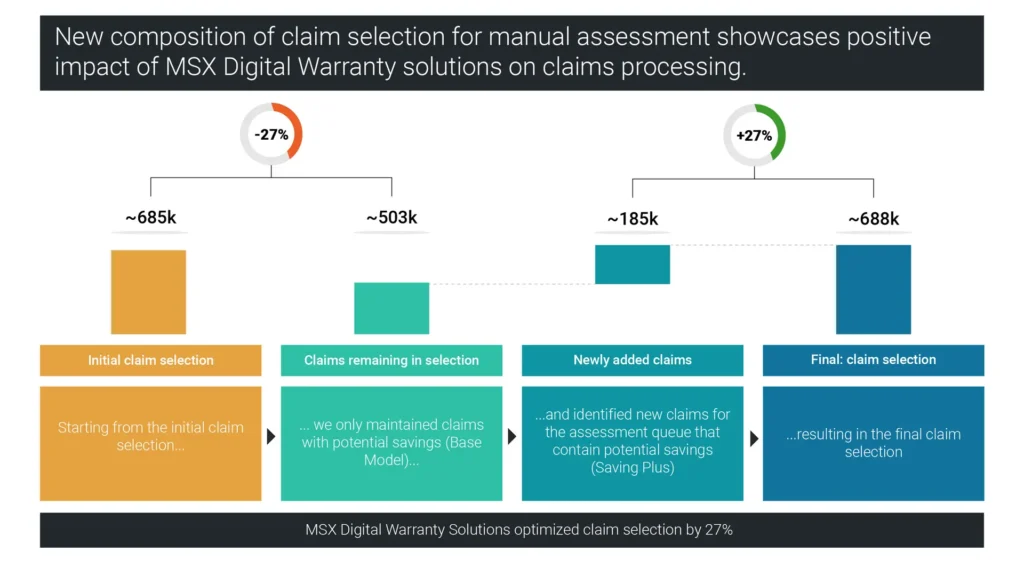
While automotive warranty processing presents intricate challenges, further exacerbated by the rise in alternative powertrains, teams are actively embracing these complexities. As they navigate through multiple IT legacy systems and disparate data sets, there’s an opportunity for streamlining operations, minimizing the risk of errors and gaining enhanced visibility into the dynamic landscape of warranty processing. The following graphic demonstrates how a change in the claim selection process can significantly increase savings.

Source: MSX

In the example above, 27% of the initial claim selection was identified as not producing any savings or not being a compliance risk, and therefore automated and removed from the assessment queue. The queue can now be topped up with a further 27% of newly added claims and repeat the process. This allows for significantly increased savings with the same number of claims, and with no investment from a human perspective.


Unlock process optimization and compliance

While humans have limitations in terms of processing information and multitasking, digital warranty solutions offer invaluable assistance. By harnessing AI and automation, OEMs can handle more claims in less time and streamline warranty processes, enabling more accurate decision-making and enhancing overall operational performance.

The primary focus of OEMs when it comes to warranty management is compliance with their policies and procedures, ensuring repairs are performed as prescribed and maintaining the quality and reliability of their vehicles. But what is equally as important is achieving cost savings. Finding a more cost-effective solution to their warranty management helps OEMs improve profitability, enhance customer satisfactions and remain competitive.

Digital warranty solutions not only offer the compliance and cost-efficiency desired by most OEMs, but they can also help standardize the warranty approach at a global level, reducing variations and inconsistencies in warranty practices and enabling OEMs to gather and analyze warranty-related data which can be used to support better decision-making and help identify trends, patterns and potential areas for improvement.

Optimize efficiency and achieve savings with AI

With millions of claims to process, OEMs can select only a limited number for manual review. Identifying those that generate savings or lack compliance can be difficult. An AI-driven claims assessing tool uses algorithms to score all incoming claims according to criteria such as potential savings and probability for deficiency or potential risk. It highlights the claims that will generate savings or are not compliant with the OEM’s policies and procedures. The claims that are high risk are then sent for manual review, and the low-value, low-risk claims are selected for automated processing.

But implementing digital solutions alone won’t achieve these results. Human knowledge of AI combined with automotive, warranty and technical expertise ensures that the algorithms are accurate and that the machine delivers accurate data. An integrated control agent continually reviews both the input and the output, conducting regular A/B testing on the algorithms and making any necessary changes to the criteria to ensure the tool continues to identify all claims with potential savings.

This model has the potential to considerably reduce an OEM’s warranty spend. By reviewing and scoring all claims in real time, the solution can change the mix of manually processed and automated claims in the backlog, sending only those low-risk claims for automatic processing and maximizing potential savings.

Leverage automation for seamless claims processing

Introducing automation into your digital warranty solution helps deliver consistency at scale, ensuring that claims are treated in the same way regardless of who processes them, and providing the same experience to dealers across the network.

In addition to processing low-risk claims, automated tools can also handle smaller tasks within a claim assessment, such as repetitive actions or routine tasks. This ensures that agents remain focused on completing the tasks that require manual input, using their knowledge and skills to generate savings for the business. It also means that every single investment adds value to the organization.

Source: MSX

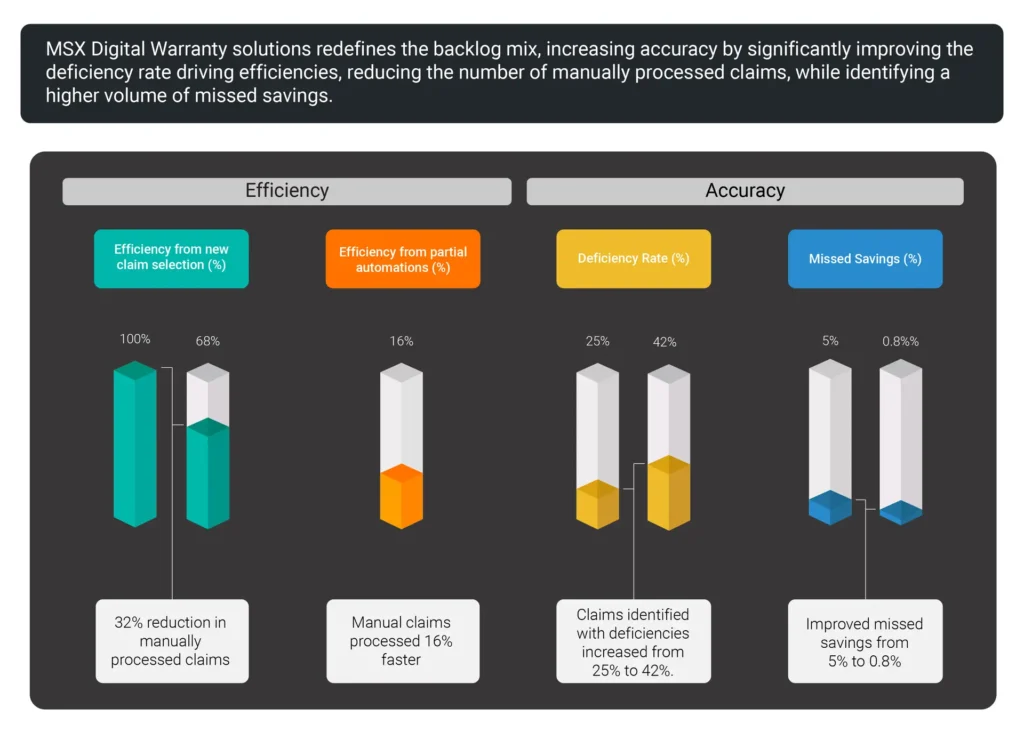
The above example shows how MSX was able to improve efficiency and accuracy with the introduction of automation. We reduced the number of manually processed claims by 32% and improved processing times for those manually processed claims by 16%. We also increased the percentage of claims identified with deficiencies from 25% to 42%, meaning that fewer claims with savings were missed.

Harness data insights for continuous improvement

Digital warranty solutions not only improve warranty processing, but they also facilitate the gathering and analysis of warranty-related data. By monitoring the performance of a solution on an ongoing basis, results can be fed back into the integrated control agent module for further A/B testing, challenging new rules and fine-tuning the algorithms for additional product enhancement.

These solutions can also find areas for improvement and identify emerging trends and patterns, sharing actionable insights with the network for continuous development and helping define strategies based on the needs of the industry.

MSX Digital Warranty and Repair Efficiency solutions can help brands take control of their warranty operations, increasing efficiency, reducing processing times, and accelerating warranty claim decisions. Through the introduction of AI and automation, we can generate real value for businesses by cutting the cost of warranty claims handling and auditing, improving accuracy, and reducing warranty waste. By lowering claim processing times, we also help businesses increase customer and partner satisfaction.

For more information on our Digital Warranty solutions, get in touch today.


Contact the Author

Pasquale_aloi.png.png

Pasquale Aloi

Global Solutions Leader, Warranty and Repair Efficiency

Pasquale_aloi.png.png

Pasquale Aloi

Global Solutions Leader, Warranty and Repair Efficiency

Related Articles