Retail denial: Why automotive strategies are dying in the showroom

Retail denial: Why automotive strategies are dying in the showroom

Automotive retail is currently suffering from a dangerous disconnect. While many head offices are moving away from a single sales model in favor of flexible hybrid arrangements, a new gap is opening between strategy and reality.

These hybrid models are designed to find a perfect balance: OEMs can act as agents for high-value products to maintain brand control, while dealers keep their independence in other areas to stay responsive to their local markets. It sounds like the perfect compromise, but the execution is falling further behind. We are seeing an industry-wide “denial gap,” where the sheer complexity of managing these blended roles is quietly suffocating the very transformations designed to save the network.

We launched our nine-week Sales and Revenue Transformation campaign to move beyond theoretical discussions and uncover where the commercial journey is actually breaking down. By examining the transition to these new hybrid models and the resulting pressure points in retail and service, we aimed to identify the practical barriers that prevent MSX clients – both OEMs and dealer groups – from recovering lost revenue.

The feedback from over 500 automotive specialists, retail leaders, and commercial experts who participated in our research was clear: the industry doesn’t have a strategy problem. It has an execution crisis.

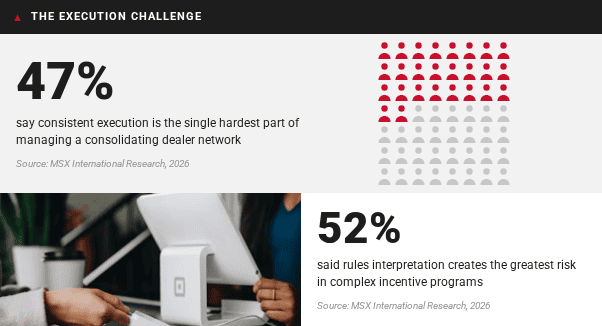
Across the campaign, the findings pointed to the same underlying issue. 47% of respondents identified consistent execution as the hardest part of managing a consolidating dealer network, while 52% said rules interpretation creates the greatest risk in complex incentive programs. In both cases, the challenge is clear: strategy only delivers value when people across the network can understand it, apply it, and act on it consistently.

Graph showing 47% struggle with consistent execution in automotive retail.

This is the point where high-level strategy often meets a dead end. A transformation only matters if it changes what happens between a salesperson and a customer, or a service advisor and a vehicle owner. If it doesn’t scale consistently across every market and every touchpoint, it isn’t transformation – it’s just paperwork.

Changing the sales model won’t fix a visibility problem

The industry is racing toward agency and hybrid models in search of control. But control requires clarity. Our research found that role clarity and network visibility were the primary concerns for 32% of respondents in these new models.

Graph showing 32% of respondents cite role clarity and network visibility concerns.
If a dealer doesn’t know where their responsibility ends and the OEM’s begins, the customer will be the first to find out. MSX CX Consultancy helps brands bridge this gap by redesigning journeys that actually function in a multi-channel world. To protect conversion at the digital stage, solutions like MSX E.COM Personal Landing Pages and MSX Consumer Engagement Solutions ensure that the customer doesn’t fall through the cracks of a disconnected handoff.

Scale is currently the enemy of consistency

As dealer groups consolidate, they gain massive scale – but they often lose grip on the “how.” When nearly half of the industry says consistency is their biggest headache, it proves that “bigger” isn’t “better” without a way to steer the ship.

You cannot manage a global network through a rear-view mirror. MSX ENGAGE provides the alignment necessary to keep large groups moving in unison, while APPRAISO turns static compliance into dynamic performance steering. If you can’t see the gap, you can’t close it.

Incentive complexity is an execution problem

Incentive schemes only steer behavior if the network understands them. Our research found that 52% of respondents identify rules interpretation as the greatest risk in complex programs, far outweighing concerns over audit readiness.

When rules are open to interpretation, inconsistency quickly erodes claims accuracy and partner trust. MSX Sales Incentive Audit program can support automotive brands in strengthening the governance, clarity, and audit trail behind incentive programs, helping ensure commercial activity is measured and rewarded with greater confidence.

Aftersales is where your revenue is leaking

While the industry obsesses over the “new car” sales model, the largest profit pool – aftersales – is under-managed. 34% of respondents identified service booking as the number one source of revenue leakage, outranking online leads and showroom follow-ups.

Graph showing 34% revenue leakage from service booking in automotive industry.

We are seeing a market where customers prioritize speed and ease over brand loyalty. If your booking journey is a barrier, your revenue is already gone. In the article Is convenience killing the automotive service industry?, we highlight that convenience is the new currency. MSX Mobile Service is a direct response to this, reclaiming capacity and utilization by meeting the customer where they are, rather than waiting for them to show up.

Data is noise if it doesn’t drive coaching

We are drowning in data but starving for insight. 30% of professionals told us that coaching impact and service performance are their biggest blind spots.

As we explored in Is the traditional KPI dead?, reporting what happened last month is no longer a management strategy. MSX Sales Performance uses diagnostics to uncover the why behind the numbers, ensuring that every intervention is targeted and measurable.

Stop training, start coaching

Perhaps the most telling finding was that 34% of respondents blame inconsistent coaching for stalling sales improvement, while 29% cited low adoption.

Graph showing coaching and adoption gap in automotive sales strategies.
The traditional “classroom” approach to retail improvement is failing. Change only happens when it is reinforced locally and daily. MSX COACH and our wider Learning Solutions move capability building out of the HR department and into the showroom flow, ensuring that strategy actually translates into behavior.

High stakes for high performance

The automotive retail landscape is being rebuilt. Whether the resulting structure is profitable or simply more complex depends entirely on your ability to close the gap between what you say you will do and what your network actually delivers. Transformation should not be a pilot program that never reaches scale; it should be the standard.

Your strategy is only as good as its last mile. If your transformation isn’t reaching the showroom floor, it isn’t delivering value.

Don’t let your strategy stall at the showroom door. Contact MSX to discuss how we can help you bridge the gap between strategy and a high-performing network.

Related Articles

The profit lifecycle: Where automotive profit is really won

The profit lifecycle: Where automotive profit is really won

Stop looking for profit in the wrong places. Profit is often viewed as the result of financial performance. It appears in margin reports, return on sales figures, aftersales revenue, and year-end results. Those measures matter, but they only tell part of the story. They show the outcome, not how it was achieved.

The reality is that profit is created, protected, and sometimes lost long before it appears on a financial statement. It starts when a vehicle enters the market and continues through every customer interaction, service visit, repair, recall, and operational decision that follows.

Between market entry and aftersales, the sales journey also plays a critical role in profitability. Solutions such as E.COM Personal Landing Pages and APPRAISO help brands strengthen customer engagement, support retailer performance, and create value from the moment a vehicle becomes available.

The organizations that consistently outperform their competitors understand that profitability is not owned by one department. It is influenced by how effectively the entire business works together. Faster market entry. Better repair quality. Reduced vehicle downtime. Smarter customer engagement. More efficient recalls. Stronger technical support. These may be viewed as separate activities, but each plays a role in shaping commercial outcomes. The most successful automotive businesses are beginning to connect these dots. They are shifting their focus from measuring profit at the end of the journey to understanding how value is created at every stage of it. Because in today’s automotive industry, profit doesn’t simply appear in the numbers. It follows the vehicle. It begins before the vehicle reaches the customer.

Homologation is often treated as a compliance task. In reality, it affects launch timing, internal coordination, retailer readiness, and time to market. When approvals move smoothly and documentation is well managed, businesses protect commercial momentum. When they do not, delay becomes cost. That is one reason MSX Homologation Services matter from a profitability point of view, not only a regulatory one

Once the vehicle is in market, profit becomes even more operational.

A sale creates revenue. The ownership journey determines how much value is retained and grown. Service access, technical accuracy, convenience, recall execution, and customer communication all shape whether a customer stays loyal and whether the network runs efficiently. This is where many organizations still underestimate margin loss.

In Is convenience killing the automotive service industry?, MSX highlighted something the industry is feeling every day: convenience has become a real driver of customer retention. If customers cannot book quickly, get clear updates, or access flexible service options, the cost is not only dissatisfaction. It is missed revenue, weaker retention, and lower lifetime value.

Customer engagement shows the same pattern. A leading automotive brand improved call conversion by 18% and achieved a further 6% conversion uplift through WhatsApp by moving from static outreach to real-time, needs-based contact. Better timing. Better relevance. Better results. Read the full story  .

Inside the workshop, profit is shaped by speed and clarity.

When technicians spend too long searching for repair information, or support teams are buried in repeat queries, productivity falls and downtime rises. In validation work with a leading multinational manufacturer, the MSX AI Virtual Assistant reduced support tickets by 30% and improved response times by 15% by helping technicians access technical service bulletins, repair manuals, and diagnostic trouble codes faster. That is operational efficiency with a direct commercial effect.

Repair quality is another area where workshop performance shapes profitability in ways that are easy to overlook. Repeat repairs, inconsistent diagnosis, and poor repair order discipline all create cost: rework, warranty exposure, customer dissatisfaction, and avoidable operational expense. MSX Repair Quality Support addresses this through a structured, data-led program that helps OEMs and dealer networks improve first-time fix rates (FTFR), standardize repair execution, and prioritize intervention where it has the greatest impact. The results are measurable: up to a 5% improvement in first-time fix and up to a 20% productivity increase across the network.

The same is true for technical content. Documentation often sits in the background, but slow publishing cycles and fragmented authoring processes create friction across the network. pubFoundry helps improve content flow, consistency, and speed, which supports better service performance and more efficient knowledge sharing.

A wider shift is happening here too.

This shift is changing how automotive businesses think about performance. In Beyond the numbers and Is the traditional KPI dead?, MSX explored why historical KPIs alone are no longer enough. Organizations need better context, better prediction, and a clearer understanding of what is driving performance – not just what has already happened.

That shift matters because profit is easier to protect when organizations can see problems early and act before cost becomes visible.

Profit is easiest to lose when complexity increases.

Recalls also deserve a place in the profit conversation. Poorly managed recalls do more than add cost. They put pressure on capacity, frustrate customers, and weaken trust. MSX Recall Management helps coordinate scheduling, capacity, and customer contact so that recalls are completed more efficiently and with less disruption. For fleet operators and mobility providers, lifecycle risk makes the point even more clearly. In this customer success story: Increasing fleet reliability, MSX showed how a preventative maintenance model could help a logistics operator avoid up to $13 million in annual spend. That is what happens when data is used early enough to protect value before cost becomes visible.

So where is profit really created?

Across all of these examples, the message is consistent: Profit is shaped through operational decisions, customer experience, service efficiency, compliance readiness, technical support, and lifecycle management.

In other words, profit follows the vehicle. The organizations that understand the profit lifecycle will be better positioned to identify hidden margin loss, strengthen customer loyalty, and create sustainable performance at every stage of the journey.

The question is not whether profit is being won or lost. The question is where.

Which stage of the vehicle lifecycle has the greatest impact on profitability in your organization? Connect with us to continue the discussion.

Related Articles

The $4 Billion Connected Services Gap: Why retail execution – not technology – is holding back your subscription revenue

The $4 Billion Connected Services Gap: Why retail execution – not technology – is holding back your subscription revenue

Fast facts

Global, top-5 automotive OEM

Despite significant investment in offering connected vehicle services, subscription uptake does not meet expectations. There is substantial potential to strengthen capabilities at retail to sell digital value at scale.

180 dealers across North America

MSX helped redesign the retail operating model, embedding digital subscriptions into the sales process, equipping frontline teams with datadriven tools and building a scalable system for long-term growth.

Turning a decade of missed opportunity into tenfold ROI

For years, connected vehicle subscriptions have been treated as a product challenge: build the features, and adoption will follow. Yet many automotive brands still face underwhelming uptake because the “last mile” of retail is not optimized to sell digital value. MSX International partnered with a global top-five OEM to redesign the retail operating model, embedding digital services into the sales process and equipping frontline teams with the data-driven tools needed to succeed at scale.

This report focuses on transforming connected services from a retail challenge into a sustainable, recurring profit stream. It shows how a structured approach to coaching, data discipline, and retail enablement can deliver exponential growth in digital purchases and modem activations. Moving from hardware to software monetization requires more than just new technology—it requires a shift in the entire retail mindset to capture value across the vehicle’s lifetime.

Download the full case study to discover how MSX International can help you redesign your retail operations, improve subscription uptake, and turn connectivity into a high-impact growth engine.

To stay informed about upcoming reports and events from MSX, submit your detail below.
Don’t miss out on new insights and discussions with our leadership team.

We’d love to hear from you

If you’d like to know more about MSX or how we can support your business, please fill out the form below.


Related case studies

MSX AI Sales Agents: The new engine behind automotive retail transformation

Home > Articles > MSX AI Sales Agents

MSX AI Sales Agents: The new engine behind automotive retail transformation

What if your next customer never had to repeat themselves, no matter where, when, or how they reached out?
At MSX, that’s not a future vision, it’s today’s reality. By embedding intelligent AI agents across the entire retail journey, MSX is transforming fragmented automotive experiences into seamless, brand-consistent conversations that convert. This isn’t about replacing people. It’s about empowering them and reimagining what’s possible when AI becomes the engine behind every customer interaction.

The MSX AI framework

This transformation is further amplified through MSX’s partnership with NeuraCRM – a living, intelligent ecosystem that connects social signals, omnichannel interactions, and lead data into one unified platform. NeuraCRM empowers OEMs, NSCs, and dealer networks to capture the intelligence behind customer intent in real time.

Unlike conventional rule-based bots, MSX’s AI Sales Agents are powered by generative AI, enabling them to deliver dynamic, contextual, and human-like interactions. Each agent is purpose-built to support a specific part of the customer lifecycle:

George

A product expert, George handles detailed vehicle queries with precision and depth.

Rita

A digital sales agent, Rita guides customers from initial enquiry through to contract preparation.

Nora

A voice bot, Nora manages appointment scheduling, whether for test drives or service bookings, via phone.

Luca & Emma

Operating behind the scenes, Luca and Emma aggregate external data such as market trends and registration statistics to enrich the system’s intelligence.

These agents are further enhanced by NeuraCRM’s predictive intelligence, which enables them to understand context from social media, landing pages, and web interactions, and recommend next-best actions based on behavioral patterns, ensuring that customers receive tailored, brand-consistent support whether they’re browsing, buying, or booking.

Redefining retail with embedded intelligence

What sets MSX apart is its philosophy: AI is not a bolt-on feature, but a foundational layer of the digital retail experience. It’s an integral part of the digital journey.
 
Whether launching a new model, nurturing leads, or managing end-of-term leasing, MSX’s AI agents operate as an always-on support system. This standardization ensures consistent, high-quality interactions, while preserving each brand’s unique tone and requirements.

AI that amplifies human expertise

MSX’s AI Sales Agents empower human advisors, by drawing on continuously updated knowledge bases, including brand documents and product data, to provide accurate, real-time responses. This frees up human agents to focus on complex, high-value interactions.

The standardized infrastructure allows agents to switch between brands with ease. Where once a team might have been trained on a single OEM, today’s advisors can support multiple brands, each with its own scripts and expectations, thanks to the shared AI backbone.

Omnichannel by design

Modern consumers expect flexibility. Whether they reach out via WhatsApp, Facebook, website chat, or voice, MSX ensures a consistent, AI-backed experience across all channels.

NeuraCRM’s omnichannel capabilities complement this design, enabling proactive re-engagement and seamless transitions across platforms. This is an experience particularly valued by younger, digitally native customers.

AI that builds loyalty and value

MSX’s AI Sales Agents go beyond the point-of-sale. They anticipate customer needs, optimize offers, and preserve future opportunities. For example:

By capturing insights from every engagement, MSX builds a detailed customer profile enabling more personalized and relevant interactions, while maintaining privacy through data abstraction.

Modular, scalable, and OEM-ready

Not every automaker is ready to leap into full automation, and that’s exactly why MSX’s approach works. With a modular, scalable framework, brands can choose the level of automation that suits their strategy. Whether it’s a fully autonomous retail flow or a hybrid model with manual handoffs at key moments like contract signing, MSX adapts to the rhythm of each OEM.

But adaptability is only part of the story. MSX’s AI Sales Agents are embedded across the entire customer and sales lifecycle, not as add-ons, but as strategic enablers. They bring consistency, intelligence, and brand nuance to every interaction. By fusing generative AI with a modular omnichannel infrastructure, MSX creates a digital foundation that evolves with the industry.

In a landscape where agility defines success, MSX delivers the tools, the architecture, and the intelligence to help automotive brands lead with confidence. The partnership with NeuraCRM further strengthens this foundation, offering a scalable, intelligent lead management ecosystem that adapts to diverse market needs and brand strategies.

Contact the Author

Robert_Haeusler

Robert Häusler

Global Solutions Director, Distribution and Sales Performance

Robert_Haeusler

Robert Häusler

Global Solutions Director, Distribution and Sales Performance

Related Articles

Navigating the automotive sales transformation: Strategies for established OEMs and disruptors

Navigating the automotive sales transformation: Strategies for established OEMs and disruptors

The automotive industry is experiencing significant transformations, driven by technological advancements, changing consumer preferences, and the entry of disruptive players. In a recent discussion, industry experts Mouna Ayed, Ralph Kranz, and Dirk Bott shed light on the evolving landscape of automotive sales. Their conversation highlights the strategies adopted by both established OEMs and disruptors to navigate these changes successfully.

Hosted by Mouna Ayed, the discussion features Ralph Kranz, a veteran in the automotive industry with 25 years of experience, and Dirk Bott, Global Vice President at MSX International. Both guests bring valuable insights from their extensive backgrounds in the field.

Different approaches to market

In the ever-evolving landscape of automotive sales, a contrast emerges between established OEMs and disruptors, each grappling with distinct challenges and leveraging unique strategies. Disruptors, including Chinese automakers, enter the scene with a focus on conquering customers in a saturated market. Their emphasis on customer trust and confidence takes shape through a user-centric, direct-to-consumer approach, challenging traditional norms.

This disruption significantly impacts established OEMs, compelling them to reassess their communication strategies. While disruptors thrive on direct communication and agile decision-making, geographical coverage poses a hurdle. Both disruptors and established OEMs find themselves navigating critical elements of the customer journey, lead conversion rates, and quick decision making to secure their market positions.

Adopting an innovative and visionary strategy

Customer engagement has become critical for the success of both disruptors and established OEMs, striving to engage the modern consumer effectively. Meeting the demand for a seamless online and offline experience requires a strategic transformation, the key to which lies in the ability to construct a flexible and innovative customer journey.

Established OEMs must adapt to a dynamic market that demands flexibility and innovation. Structural changes, including the integration of digital tools, become imperative for cost efficiency and heightened productivity. In the race against disruptors, they must focus on their brand loyalty, compelling narratives, and finding the right balance between innovation and market demands. But learning from disruptors’ flexibility and innovation is fast becoming essential, guiding established OEMs in crafting strategies that amalgamate tradition and innovation seamlessly.

For disruptors, the key lessons involve innovating, crafting a compelling brand narrative, and maintaining a balance between disruption and market demand. Fundamental elements, such as a well-structured sales funnel and an effective go-to-market strategy are crucial for lasting success.

The focus for a successful future

As established OEMs carve out a clear brand positioning that accentuates speed, flexibility, and customer-centricity, disruptors must persist in their innovative approaches while fine-tuning essential elements like sales funnels and go-to-market strategies. However, future success for all parties relies on an investment in a strong brand narrative and the adoption of lean organizational structures, laying the groundwork for a sustainable and profitable future for both established OEMs and disruptors alike.

Contact the Author

9[1]

Dirk Bott

Global VP Sales Performance and Distribution and Consumer Engagement

9[1]

Dirk Bott

Global VP Sales Performance and Distribution and Consumer Engagement

Related Articles

Transforming EV lead conversion: Delivering tailored, data-driven customer experiences

Transforming EV lead conversion: Delivering tailored, data-driven customer experiences

Fast facts

European volume OEM

With an excess of electric vehicles returning from leasing contracts, the OEM needed a more personalized approach to optimize customer engagement and sales conversion rates.

Germany

MSX E.COM Personal Landing Page (PLP) program delivered tailored, data-driven experiences for customers, allowing for automated communications and follow-ups, and provided clear options for customers to buy, extend their lease, or opt out.

A European volume OEM found itself with an excess of electric vehicles returning from leasing contracts that needed to be sold or have their lease terms extended. Despite the inherent customer interest, the traditional lead conversion approach lacked the level of personalization needed to optimize customer engagement and conversion rates.

The organization approached MSX with the specific challenge and sought a comprehensive solution that could transform its sales approach. MSX recognized the need for a more dynamic and personalized customer engagement strategy to effectively manage the influx of returning electric vehicles.

Without a digital strategy that could support direct and tailored communication, the OEM’s existing sales processes were proving inefficient. The retail group required a solution that could centralize customer interactions, streamline communications, and drive higher conversions.

MSX implemented its innovative MSX E.COM Personal Landing Page (PLP) program to address the client’s needs. The PLP program is designed to create personalized and OEM branded data-driven experiences for customers by combining advanced software and automated communication strategies.


Introducing personalized digital strategies

To address the challenge, MSX implemented a solution centered around customized PLPs. Each lead, or customer, received a unique landing page tailored specifically to their vehicle details and status in the sales funnel. This personalized approach allowed customers to view offers that were relevant to their lease status and preferences, whether it was to purchase their current vehicle or extend their lease. By providing this level of customization, they could engage customers more effectively and cater to their individual needs.

The system also featured automated communication and engagement, which played a crucial role in maintaining customer interest. Personalized emails and follow-up messages were automatically triggered based on each customer’s response and engagement levels. If a customer did not respond within three days, the system would initiate additional outreach via the PLP or a specialized inside sales agent to keep the customer engaged. This automation ensured that no potential lead was overlooked, and that communication remained consistent and timely.

Each PLP provided customers with three straightforward options: to buy the car, extend the lease, or opt out. This clarity, combined with a user-friendly interface, empowered customers to make decisions on their own terms. By simplifying the choices and making the process transparent, the OEM could enhance customer satisfaction and trust.

The PLP campaign was designed to operate with minimal human intervention, allowing the sales teams to focus on high-potential leads. The automated system managed the bulk of the interactions, ensuring that within two months, all 1,300 customers received a consistent and personalized experience. This approach not only improved efficiency but also allowed the sales team to allocate their efforts more strategically, ultimately driving higher conversion rates.

Each PLP provided customers with three straightforward options: to buy the car, extend the lease, or opt out. This clarity, combined with a user-friendly interface, empowered customers to make decisions on their own terms. By simplifying the choices and making the process transparent, the OEM could enhance customer satisfaction and trust.

The PLP campaign was designed to operate with minimal human intervention, allowing the sales teams to focus on high-potential leads. The automated system managed the bulk of the interactions, ensuring that within two months, all 1,300 customers received a consistent and personalized experience. This approach not only improved efficiency but also allowed the sales team to allocate their efforts more strategically, ultimately driving higher conversion rates.

Transforming sales with automated communication

The introduction of MSX’s PLP program brought several significant benefits to the OEM’s sales process. One of the most notable advantages was the enhanced personalization of customer interactions. Each communication and offer were tailored to the customer’s current situation and preferences, ensuring that every message was relevant and engaging. This level of customization helped build stronger relationships with customers and increased their likelihood of responding positively to the offers presented.

The system automated all communications and follow-ups, which significantly reduced the manual workload for the OEM’s salesforce. This automation ensured that messages were sent in a timely and consistent manner, maintaining customer engagement without the need for constant manual intervention. As a result, the sales teams could focus their efforts on more strategic tasks, knowing that the system was handling routine follow-ups efficiently.

With a centralized platform to track responses and analyze customer behaviors, The group’s sales teams could easily identify and prioritize the hottest leads. This streamlined approach allowed for a more efficient use of resources, as the teams could concentrate on leads that were most likely to convert. The ability to quickly and accurately assess customer interest meant that sales efforts were more targeted and effective.

By combining advanced software with automated communication strategies, the OEM was able to engage customers more effectively and drive higher levels of engagement. The result was a significant increase in conversions, demonstrating the value of a tailored, data-driven approach to customer interaction and sales management.

Optimizing sales with data insights

The results of the PLP campaign were exceptional, showcasing the potential of MSX’s data-driven sales strategies. Out of 1,300 potential leads, the campaign generated over 500 conversions, with 300 customers signing contracts to purchase their vehicles directly through the PLP and an additional 200 supported through other sales channels. This translated into a 43% conversion rate from engaged leads to hot leads, significantly higher than traditional sales methods, demonstrating the effectiveness of personalized communication in capturing customer interest.

They also saw an 80% improvement in segmentation accuracy, allowing them to target their communications more precisely. Additionally, there was a 63% success rate in personalized outreach compared to their standard, non-personalized campaigns. These metrics highlight the efficiency and effectiveness of the PLP program in enhancing customer engagement and driving sales.

By blending innovative technology with human-centric processes, our client was able to achieve superior outcomes, leveraging MSX E.COM’s capabilities to move inventory quickly, engage customers more effectively, and transform their approach to lead management and conversion.

The combination of a tailored PLP solution, data-driven insights, and automated communication resulted in a comprehensive solution that went beyond addressing their immediate challenge. It set a new standard for personalized customer engagement in automotive sales. The program’s success is a clear indicator of how a well-executed PLP solution can drive tangible business results, paving the way for future implementations across their network.

More than 500 conversions, including 300 direct purchases and 200 through other channels.

Conversion rate from engaged leads to hot leads.
0 %
Improvement in segmentation accuracy.
0 %
Success rate in personalized outreach compared to standard campaigns.
0 %

Related case studies

Optimizing conversions: Boosting efficiency and driving growth with non-human lead management

Optimizing conversions: Boosting efficiency and driving growth with non-human lead management

Fast facts

An American EV disruptor

Struggling with inefficiencies and conversion rates in lead management, particularly when it comes to integrating human interactions with digital tools, our client identified a pressing need for a solution that would allow customers to choose how they communicate, while also enabling them to maintain a high level of personalization and efficiency.

Europe

A digital solution that merges cutting-edge AI, automation, and human interaction to create a flexible, scalable, and modular approach to lead management, catering to different customer preferences while ensuring cost efficiency for OEMs.

The automotive industry has long faced challenges in lead management, especially in seamlessly integrating human interactions with digital tools and ensuring transparent follow-up throughout the sales journey to the point of conversion. Balancing customer preferences for personalized communication with the need for scalable and cost-effective processes can be a challenge for OEMs. Additionally, fluctuating workloads make it difficult to rely solely on full-time employees (FTEs), as human interactions require flexibility that can be difficult to achieve with a traditional workforce.

While most OEMs run marketing campaigns across various digital platforms such as Meta, Instagram, and LinkedIn, they often struggle to effectively capture and engage leads. They require the correct coding in place to capture lead data and turn this initial interest into successful conversions via personalized interactions. However, some customers still value human contact, especially when making significant decisions like purchasing a vehicle.

One American EV disruptor urgently needed a solution that would allow customers to choose their preferred communication methods, while also enabling them to maintain high levels of personalization and efficiency. This solution would ensure continuous follow-up throughout the sales journey, from lead to conversion.

Merging AI, automation, and human interaction

MSX developed an innovative, digital lead management solution that merges cutting-edge AI, automation, and human interaction to create a flexible, scalable process. This approach was designed to cater to different customer preferences while ensuring cost efficiency for OEMs.

The key to this solution is a modular approach to lead management that could adapt to varying levels of human involvement. Using advanced data gathering techniques from a variety of channels (including dealer systems, customer relationships management platforms, and social media channels), MSX compiled leads from diverse sources like Meta, Instagram, and web advertisements. Once customer data was captured, the system applied sophisticated clustering algorithms, utilizing 12 criteria to categorize leads into five distinct clusters based on purchase intent. This granular approach allowed for highly targeted communication tailored to the needs of each customer.

person-working-futuristic-office

” By implementing a digital-first approach with minimal human interaction, the company saw a dramatic increase in lead conversion rates, boosting discovery-to-conversion rates from 50% to 90%.”

Personalizing the customer journey

Customers were then presented with personalized landing pages (PLPs) that contained detailed vehicle information, offers, and options for further engagement. Depending on their cluster, customers could choose to continue their journey digitally via WhatsApp, connect with a salesperson, or schedule a test drive. The entire process, from lead generation to the final stages of conversion, was streamlined and digital, with human involvement only occurring when necessary—such as during a test drive.

In less than two months, MSX successfully developed a customized digital solution that aligned with the specific brand DNA and met the unique expectations of its customers, an impressive achievement given the complexity of the integration across multiple platforms. The modular design is fully customizable, allowing OEMs to adjust the level of human interaction as needed, depending on customer preferences or campaign demands. Whether the OEM is running a new vehicle launch, a seasonal campaign, or targeting a specific geographic region, the system’s scalability ensures that resources can be adjusted quickly and efficiently.

This approach allows the OEM, or lead management hub, to select only the elements they need, such as digital lead capture, personalized communication via PLPs, or direct sales team integration, making this solution flexible, and adaptable to the unique needs of the client.

Delivering unmatched efficiency and engagement

MSX’s digital lead management solution offered a host of benefits that addressed the OEM’s challenges and exceeded expectations:

  • Cost efficient

    By reducing reliance on full-time employees (FTEs), the solution lowered labor costs and optimized resource usage. The ability to scale human interaction up or down based on demand provided significant operational savings.

  • Scalable and fexible

    The system is highly adaptable to different market conditions, campaigns, and geographic expansions. The OEM quickly adjusted their approach based on shifting customer needs or varying lead volumes.

  • Personalized engagement

    With advanced AI and data clustering, MSX was able to deliver highly personalized customer experiences. The use of customer intelligence platforms (CIP) and customer data platforms (CDP) allowed for better targeting, improving the relevance of messages sent to leads.

  • Higher conversation rates

    By delivering tailored communications and allowing customers to choose how they interact with the brand, MSX’s solution increased lead conversion rates. The personalized landing pages, targeted offers, and seamless transition to human sales agents or digital tools significantly improved customer engagement.

  • Data migration

    The system allows two-way communication via data API migration, meaning there’s no need for a complex CRM integration or DMS interface. An MSX layer over the existing CRM provides more robust functionality and flexibility, while significantly enhancing convenience for both customers and the network.

By integrating AI, automation, and personalized customer experiences, MSX provided a solution that not only boosted operational efficiency but also significantly enhanced customer engagement and conversion rates. The OEM now benefits from a scalable, flexible solution that can be tailored to meet the demands of a rapidly evolving market, keeping them ahead of the competition while delivering exceptional customer experiences. Additionally, the entire sales journey is meticulously documented, offering the OEM transparent and detailed reporting at every stage.

Related case studies

Empowering electric mobility: A case of market expansion and transformation

Empowering electric mobility: A case of market expansion and transformation

Fast facts

An emerging electric vehicle (EV) charging service provider

With plans to enter new markets, they needed to fully understand the regulatory requirements and local market dynamics and develop a successful expansion strategy. 

European markets

A go-to-market strategy and sales prospecting approach for identifying and engaging with potential customers, as well as utilizing MSX’s infrastructure and existing industry knowledge.


Navigating a strategic shift

An established electric vehicle (EV) charging service provider found success in Germany, France, Spain, and Italy. Pioneering an innovative model focused on off-grid infrastructure as a service, they are set to transform the European landscape with revolutionary mobile fast charging solutions.

In their pursuit of control across other European markets, they teamed up with MSX for dedicated support in shaping and executing a robust go-to-market strategy in a bid to win sustainable electric mobility dominance.

Having been operating previously in parts of France, Italy, and Spain, an EV charging service provider launched their services in Munich and Berlin in 2022. They offer an off-grid mobile charging service comprising a mobile unit that provides fast charging on the road. In 2024, they plan to launch an innovative battery storage system with DC/AC charging capabilities, developed by its own hardware and software engineers. Their goal, with these two solutions, is to help promote the transition to electric mobility in Europe.

However, they are changing their approach from energy delivery and mobile charging to a Charging Point Operator (CPO). As a CPO, they will be responsible for producing and delivering not only the batteries and the mobile charging services, but also managing the overall infrastructure, installation, and payment function, creating new opportunities with new potential customers.

As they plan to expand their operations and enter new markets, it’s vital they fully understand the regulatory requirements and local market dynamics and conduct a competitor analysis that enables them to make informed decisions and develop successful expansion strategies.

Once this strategy is defined, they must then launch their products and services in a way that maximizes market penetration, revenue generation, and brand awareness while defining their market entry strategy. Other important factors which must also be considered are identifying and defining their target customers, developing a pricing structure, and assessing the scalability and growth potential in new markets.

In 2023, they commissioned MSX to support in developing their business, by setting up a dedicated organization to oversee market research, feasibility studies, and operational setup, as well as utilizing MSX’s infrastructure and existing industry knowledge, including those with international Urban Mobility representants.

Scaling and building relationships

Using our competencies and experience, MSX developed a go-to-market strategy, designed to broaden our clients’ geographical coverage and introduce new customers.

This, along with an expertly crafted sales prospecting approach for identifying and engaging with potential customers would help them define the best customers or commercial entities to target based on the products that are applicable to them.

The solution enabled our client to grow their business development pipeline, build relationships, increase conversion rates, and expand into new markets. MSX established a specialized dedicated Business Development Team that included a dynamic salesforce and an Operational Solutions Manager (OSM). The OSM would oversee the relationship between the client and MSX, managing the sales team, and addressing any additional support requests from the MSX organization.

The OSM and salesforce collaboratively devised a strategy to attract potential customers’ attention, identifying both quick wins and long-term business opportunities. Their plan involved securing appointments and winning new business. Additionally, they aimed to create customized information and marketing materials for effective business development and seamless implementation of our client’s solutions.

Outcome: Accelerating competence, confidence, and compliance

The program achieved significant customer reach in Germany, connecting with over 400 contacts.

This improved the company’s brand awareness and visibility in the German market. Additionally, the development of a comprehensive overview of their product portfolio, complete with compelling commercial arguments, empowered the sales teams to approach a high volume of potential leads. The attractive product catalog played a pivotal role in showcasing their offerings.

The continuous refinement of the business focus ensures alignment with market needs and evolving trends. Clearly defining client requirements for the hardware selling proposition is crucial. Collecting and sharing relevant information allows for a more targeted sales approach. Market feedback provided insights into what worked well and areas for improvement.

Overall, our client’s solutions have gained interest from various sectors, including company fleets, road assistance providers, insurance companies, and fuel stations. As charging infrastructure continues to evolve, our client is now well-positioned to capitalize on these opportunities.

Net savings of

0

on travel expenses

Reduced lead time from

0 -3

months

Connected with over

0

contacts expanding market presence

Open doors to key players and system providers in the

EV-charging business

Detailed product catalog  

enabled sales teams to engage potential leads

To find out how MSX can help expand your business, visit:

Related case studies

Boosting EV sales confidence: MSX EV Dealer coaching sparks capability growth

Boosting EV sales confidence: MSX EV Dealer coaching sparks capability growth

Fast facts

A multinational automotive manufacturer’s European Dealer Network

Prepare dealers for the huge rise in electrification in the automotive industry in general, to re-confirm the OEM’s EV sales strategy, dealer processes, dealer supporting tools, and to fully utilize the respective dealer’s EV vehicle sales potential.

Up to 350 dealers across 16 European markets

A modular EV Sales Coaching Program introduced remote coaching, online showroom, and an increase to the number of face-to-face visits across Europe.

Challenge: Overcoming EV adoption barriers in Europe

A major multinational automotive manufacturer, who is considered one of the most advanced OEMs in this space in terms of their product platforms and technology, were facing a number of barriers to their wide-scale adoption of EVs and needed a program that would build the confidence and competence amongst the dealer network to achieve the brand’s EV sales and growth ambitions.

With the industry’s move towards electric vehicles (EVs), dealer networks across Europe need to strengthen their conviction, confidence and competence to sell EVs to prospective customers.

These challenges included dealer staff commitment to EV sales, and the limited capability of dealer staff to offer the information, guidance and reassurance sought by customers in the consideration and purchase process.

Amid mounting pressure, global OEMs are investing significantly in their transition to EV production worldwide. The success of this particular OEM in Europe hinged heavily on securing a dominant market position within the EV segment, despite fierce competition from established OEMs, Chinese manufacturers, and traditional automakers.

Solution: Strategies for accelerating EV sales

MSX, with its rich history of partnering with the OEM on various important initiatives across Europe, developed the EV Dealer Coaching initiative, which is centrally created at European HQ level, customized for individual markets, and delivered locally across key European markets.

The initiative aims to optimize EV sales for the OEM through their dealer network and encompasses various strategic activities to assess the confidence and competence of dealer staff to sell EVs, and to enhance the readiness of dealerships to embrace EVs and effectively communicate with customers. The primary objectives include ensuring the dealer management mindset is aligned with EV sales goals, establishing EV expertise within the organization, refining the test drive process, improving product presentation and service, and ensuring a memorable handover experience.

On-site analysis and coaching form the initial phase, focusing on quick wins such as setting KPIs and establishing key actions for dealers. Regional managers play a crucial role in overseeing further activities post-coaching. Follow-up and remote sessions are conducted to validate progress, prepare for coaching sessions, and adjust strategies as needed. Remote coaching sessions involve reviewing previous tasks, assessing KPIs, and setting new tasks, with outcomes shared among stakeholders.

On-site reviews serve to maintain relationships, assess progress, identify roadblocks, and agree on actions to overcome challenges. The final phase involves reviewing achievements, ensuring sustainability of changes, and agreeing on further tasks. Throughout each phase, agendas are shared in advance, and outcomes are communicated via email with dealers, regional managers, and the market, ensuring transparency and accountability in the optimization process.

Outcome: Accelerating competence, confidence, and compliance​

This comprehensive coaching program has demonstrated remarkable success and resulted in significant improvements in dealer confidence and compliance. Our strategic approach focused on uplifting underperformers and aligning new dealers with industry standards, providing access to a pan-European network of local market experts. This level of expertise ensured a tailored and effective approach that not only strengthened dealership performance but also addressed market needs.


The program’s success was driven by the implementation of individual dealer coaching, facilitated by a dealer self-rating mechanism that enabled self-reflection and acceptance of potential gaps in knowledge. Compliance checks against EV standards and sales processes reinforced coaching objectives, ensuring a targeted and impactful intervention. In addition, local marketing campaigns generated leads, particularly leveraging the growing interest in sustainable energy solutions such as solar panels. Real-time analysis and improvement of test drive data, coupled with customer feedback mechanisms, further enhanced the program’s effectiveness.


The results speak volumes, with dealer confidence in selling EVs increasing by a remarkable 16.5%. Similarly, confidence in being EV ready surged by 16.3%. Dealer compliance along the EV customer pipeline experienced a substantial 32% increase. And compliance in customer engagement saw an impressive 62% rise. These outcomes demonstrate the transformative impact of MSX’s EV Sales Coaching Program, not only in enhancing dealer capabilities but also in driving customer-centric practices across the dealership network.

Find out how MSX can improve EV confidence and compliance throughout your dealer network:

Related case studies